
The Sun’s photosphere
What Is the Photosphere?
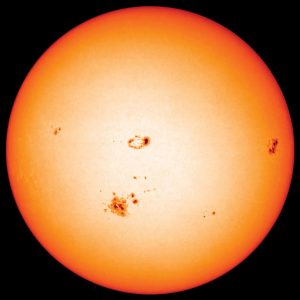
When you safely observe the Sun, the brilliant glowing surface you see is the photosphere – literally the Sun’s “sphere of light”. This is essentially the Sun’s visible surface, although it isn’t a solid surface at all. The Sun is a giant ball of gas, and the photosphere is actually a thin layer (only on the order of a few hundred kilometers thick, extremely thin compared to the Sun’s 700,000 km radius) where the gas becomes opaque and most of the Sun’s light finally escapes into space. The temperature in this layer is around 5,500 °C (about 9,900 °F) – vastly cooler than the Sun’s core, but still hot enough to shine intensely. Essentially, almost all the sunlight that warms Earth and illuminates our daytime sky comes from the photosphere.
One interesting thing you notice when viewing the Sun is that its edge (limb) looks dimmer than the center. This effect, called limb darkening, happens because when you look near the Sun’s limb, you are seeing the photosphere at a shallow angle and looking through its cooler, upper layers. At the center of the Sun’s disk you see deeper, hotter regions of the photosphere that emit more light, whereas toward the edge you’re seeing higher, cooler, dimmer gas. Limb darkening is a visual reminder that the photosphere is a layer of gas with varying temperature: it appears darker around the Sun’s outline and brighter in the middle.
Observing the Photosphere Safely
Because the photosphere is extremely bright, you must take precautions to observe it safely. Never look at the Sun directly with your eyes or through any unfiltered optical instrument – doing so can cause severe and permanent eye damage almost instantly. Instead, you need to use special methods to view the Sun safely. Here are a few safe approaches you can use to observe the Sun’s photosphere:
Solar viewing glasses (eclipse glasses): These are low-cost cardboard glasses with built-in certified solar filters that let you look at the Sun safely. Through solar viewing glasses, the Sun appears as a small disc (usually white or orange), and you may even spot a large sunspot or two as tiny dark specks if any are present. (Reminder: these filters are for naked-eye use only – never use eclipse glasses while looking through a telescope or binoculars.)
Projection method: You can observe the Sun indirectly by projecting its image. Using a telescope or even binoculars (with no eyepiece caps or filters on the optics themselves), point at the Sun and project the bright image coming out of the eyepiece onto a white card or screen held a short distance away. This method displays a large image of the Sun’s photosphere on the screen, where multiple people can view it. Sunspots will be visible as dark spots in the projected image. This technique was used by early astronomers and is still a simple, safe way to view sunspots without looking through an instrument.
Filtered telescope or binoculars: For the most detailed views, observe the Sun through a telescope (or high-power binoculars) equipped with a proper solar filter over the front of the optics. A quality white-light solar filter will block 99.999% of the Sun’s light, making it safe to look through. Even a small telescope with a certified solar filter will reveal a wealth of detail on the photosphere – you’ll easily see sunspots of various sizes, and with steady air you can glimpse the bright patches called faculae and even the Sun’s fine “granulation” texture under high magnification. Using a filtered telescope is the best way for an amateur astronomer like you to observe the photosphere’s features in real time.
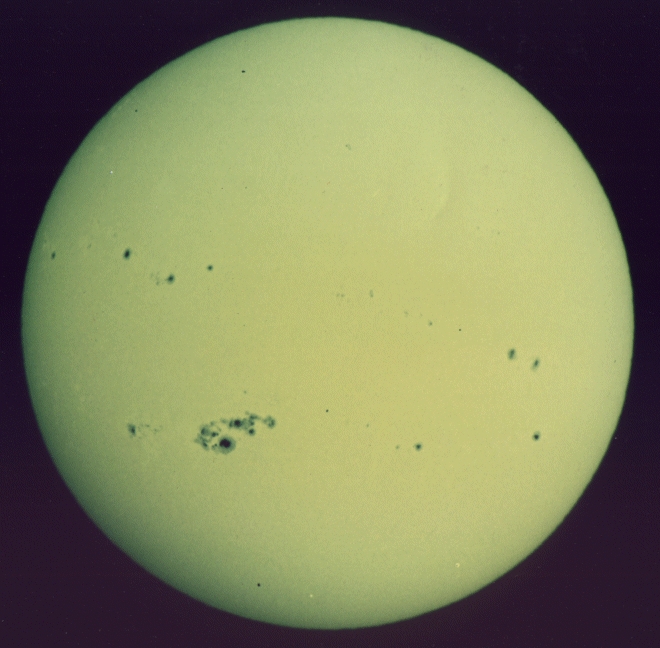
All of these methods allow you to enjoy solar observing safely. Once you have the proper setup, you can watch the Sun’s photosphere change from day to day. For example, if you track a prominent sunspot group over about a week, you’ll notice the spots slowly sliding across the Sun’s face – this is because the Sun itself is rotating (it turns about once every 27 days). By monitoring the photosphere over time, you can literally see our star in action: sunspots grow and shrink, new ones appear, and old ones dissipate. It’s a fascinating and accessible way to witness the dynamic nature of the Sun.
Features of the Photosphere
When you observe the photosphere (using proper filtration), several distinct features become apparent against the bright background. The most noticeable are sunspots, but with closer inspection or photography you can also detect a fine mottled pattern called granulation, as well as bright regions known as faculae. Each of these features reveals something about the Sun’s behavior. Below is a breakdown of the main photospheric features you can observe:
Why the Photosphere Matters
The photosphere may just be the Sun’s “surface layer,” but it has tremendous importance both for astronomers and for life on Earth. For one, the photosphere is the source of nearly all the sunlight we receive. The light and heat that make Earth habitable are radiated from this thin shell of gas around the Sun. Every time you feel the Sun’s warmth or see daylight, you are experiencing energy that last interacted with the Sun in its photosphere. In that sense, the photosphere is fundamental – it’s the interface between the Sun’s interior energy generation and the outside universe.
For astronomers (professional and amateur alike), the photosphere is also the most accessible layer of the Sun, and it serves as a window into the Sun’s behavior. By observing features on the photosphere over time, you can learn a great deal about how our star works. For example, regular monitoring of sunspots revealed that the Sun has an approximately 11-year cycle of magnetic activity: the number of sunspots rises and falls in a cycle, which corresponds to the solar magnetic cycle. During the peak of this cycle (solar maximum), dozens of sunspots may dot the photosphere, and during the low point (solar minimum) the Sun’s face can be nearly spotless. This cyclical behavior, observable through the photosphere, is key to understanding phenomena like the solar magnetic field and helps us predict periods of increased solar activity. Observing sunspots over the centuries (starting from Galileo’s time) has built a record of the Sun’s cycles and even revealed unusual periods like the Maunder Minimum (a 17th-century decades-long absence of sunspots) that are linked to changes in Earth’s climate.
Moreover, the photosphere’s features are tied to space weather that affects Earth and our technological society. Sunspots and faculae aren’t just visual curiosities – they often mark regions of intense magnetic activity that can unleash solar flares and eruptions. When magnetic fields above sunspot regions tangle and release energy, the Sun can produce a solar flare, which is a powerful burst of radiation, or even a coronal mass ejection (CME) that hurls charged particles into space. These events often originate in and around photospheric active regions (sunspot clusters). A strong flare or CME aimed toward Earth can disturb our upper atmosphere and magnetic field, sometimes knocking out radio communications, impacting satellites, or even causing voltage surges in power grids. They also produce beautiful auroras in Earth’s polar skies. In other words, activity on the Sun’s photosphere can have planet-wide effects. For instance, a large group of sunspots (an active region) might spawn flares that send X-rays and radio bursts our way – within days we may see auroral displays or minor geomagnetic storms as a result. This is why agencies like NASA and NOAA closely watch the photosphere (via satellites and telescopes) to monitor sunspots and predict space weather. For an amateur astronomer, observing these changes in the photosphere firsthand can be exciting: you could witness a sunspot region growing and know that it might produce a flare, connecting what you see in your telescope to auroras or radio interference here on Earth.
Finally, studying the Sun’s photosphere also has broader scientific importance. The Sun is our nearest star, and the photosphere is essentially the part of a star that we can directly see. By understanding the physics of the solar photosphere, we gain insight into the light from distant stars (since we usually only see the photospheres of other stars as well). The techniques and knowledge derived from observing the Sun’s photosphere – such as measuring its spectrum, tracking surface oscillations, and mapping magnetic features – help astronomers interpret the behavior of faraway stars. In this way, the Sun’s photosphere serves as a fundamental reference for stellar astronomy.