
The Sun’s corona
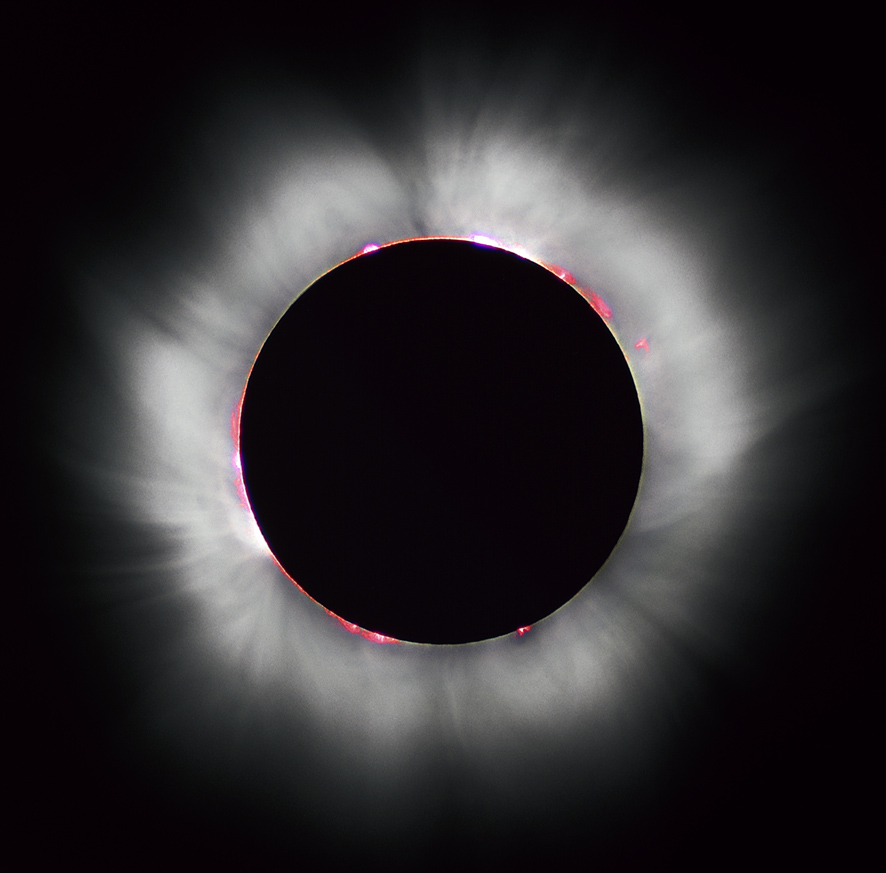
The Sun’s Corona
Imagine the Sun’s corona as a faint, ghostly halo surrounding the bright solar disk. In reality it is the Sun’s outer atmosphere, made of extremely hot, ionized gas (plasma) extending millions of kilometers into space. You normally cannot see it because the Sun’s surface (photosphere) is so bright. Only when the photosphere is blocked – for example during a total solar eclipse – does the corona become visible as a white crown of wispy rays or streamers stretching outward. Professional solar telescopes (like NASA’s SDO) and coronagraph instruments on satellites can also create an artificial eclipse to reveal the corona. The light you see in the corona is mostly sunlight scattered by free electrons in the hot gas, so the inner corona (the “K-corona”) looks whitish, while very faint outer parts (the “F-corona”) get a yellowish glow from dust scattering.
The corona has a complex structure controlled by magnetic fields. You’ll often notice helmet streamers – large arching “caps” over active regions and sunspots – with pointed tops shaped by the outward flow of solar winds. Between them you might see thinner plumes and loops, which trace magnetic field lines connecting regions of opposite polarity. Near the poles, dark coronal holes sometimes appear. These holes mark areas where the Sun’s magnetic field opens straight into space rather than looping back. In coronal holes the plasma is less dense, and these regions are known to be sources of fast solar wind. If you watch eclipse images over the solar cycle, you’ll see the corona change: at solar maximum it looks messier with many loops, while near minimum it is more symmetric with prominent streamers above the equator.
One of the strangest facts about the corona is its temperature. Although it is far from the Sun’s core, the gas here is superheated to about 1–3 million degrees Celsius (up to millions of Kelvin). That is hundreds of times hotter than the Sun’s visible surface (about 5,500 °C). Why does it get so hot? Scientists are still working on that puzzle. Some think tiny, rapid magnetic “nanoflares” or waves could deposit energy in the upper atmosphere. In any case, the corona is so hot that the gas expands outward. Pioneering solar physicist Eugene Parker showed that at a few million degrees, the thermal pressure is strong enough that the Sun’s gravity cannot hold all the plasma in place. Instead, the outer corona continuously streams out into space as the solar wind.
The solar wind is a steady flow of charged particles – mostly protons and electrons – blown off from the corona. It shoots out in all directions at speeds of a few hundred kilometers per second. Roughly a million tons of coronal material gush into space every second. This wind carries the Sun’s magnetic field with it and fills the solar system, bathing the planets in energetic particles. When these particles reach Earth, they interact with our magnetic field and can produce beautiful auroras near the poles. (As you may have heard, the intense solar wind or magnetized bursts can sometimes interfere with radio communications and satellites if strong enough.)
Every now and then, the corona releases huge bursts known as coronal mass ejections (CMEs). A CME is like a gigantic bubble or cloud of plasma threaded with magnetic fields, launched outward from the corona over hours. These events can carry billions of tons of matter and become so large that a front-side CME aimed at Earth can appear as an expanding halo around the Sun in telescope images. When a CME collides with Earth’s magnetic environment, it can trigger powerful geomagnetic storms: vivid auroras, and in extreme cases it can disrupt power grids or satellite systems. You may have seen spectacular movies of CMEs captured by SOHO or other coronagraphs. CMEs often accompany solar flares and erupting prominences, but they can happen on their own too. During solar maximum, CMEs can occur several times per day, whereas in quiet times perhaps only once per week.
Observing the Corona
Because the corona is so faint, you need special conditions or equipment to study it. Here are some ways you can observe or explore it:
Total Solar Eclipse
This is the most dramatic method. When the Moon fully covers the Sun’s bright face, the corona shines out as a glowing halo. During the few minutes of totality you can see delicate streamers and the red chromosphere edge. It’s essential to use eclipse glasses or filters to watch safely until just before totality (and again after). Planning is key: you must be in the Moon’s shadow path and have clear skies to experience the corona directly.
Coronagraphs
These are telescopes designed to block out the Sun’s disk (with an occulting disk) so the corona is visible all the time. NASA’s SOHO spacecraft carries coronagraphs (like LASCO) that continuously image the corona and CMEs. Even some skilled amateurs have built small coronagraph attachments to their telescopes. In a coronagraph you essentially create an artificial eclipse by inserting a disk that matches the Sun’s image. This lets you record coronal structures or CMEs from the ground (best from a dark, high-altitude location). Note that even tiny amounts of scattered light (from air, dust, or the optics) can overwhelm the corona – one amateur noted that at sea level the scattered blue sky is brighter than the corona – which is why eclipse or space observations are so useful.
Hydrogen-Alpha Telescopes
While not showing the white-light corona itself, these specialized solar telescopes reveal the chromosphere and prominences (clouds of hydrogen gas at the Sun’s edge) that are part of coronal activity. A 656.3 nm H‑alpha filter makes prominences glow bright red against the sky. These prominences are held up by coronal magnetic fields, so watching them (especially before or during an eruption) gives clues about coronal activity. During an eclipse you see a thin red rim – the chromosphere – but with an H‑alpha telescope you can observe those red features anytime. Modern amateur H‑alpha telescopes (like Coronado and DayStar systems) let you safely view solar activity and even capture video. (Of course never look at the unfiltered Sun; always use certified solar filters or dedicated solar telescopes.)
Satellite Data and Online Observatories
Even without your own telescope, you can “observe” the corona by looking at images from space probes. Websites for SOHO, SDO, the Parker Solar Probe, and NOAA’s space weather center post near-real-time pictures of the corona in different wavelengths. You can watch streamers shift and CMEs erupt on your computer. This data is freely available and a great resource for amateur study.