
The Sun’s convection Zone
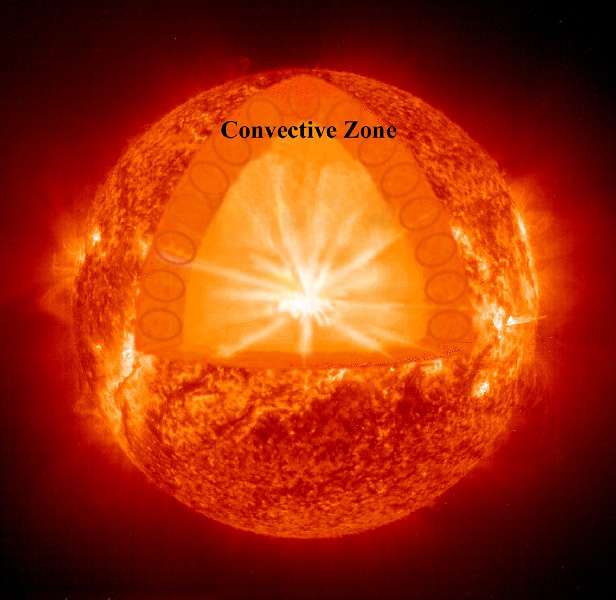
The Sun’s Convection Zone – Beneath the Boiling Surface
The Sun’s interior is layered: a central core, a radiative zone, and, above them, the convection zone as the outermost part of the Sun’s interior. When you observe the Sun (always with proper filters!), you are looking at the photosphere – the visible surface. Just below that surface, extending roughly the outer 200,000 km of the Sun’s radius (about the outer 30% by radius), lies the convection zone. In this zone, energy is no longer carried outward by photons alone, but by the churning motion of hot solar plasma – a process we call convection. Understanding this convection zone is key to explaining many of the dynamic features you see on the Sun’s surface and the activity in its atmosphere.
How the Convection Zone Works
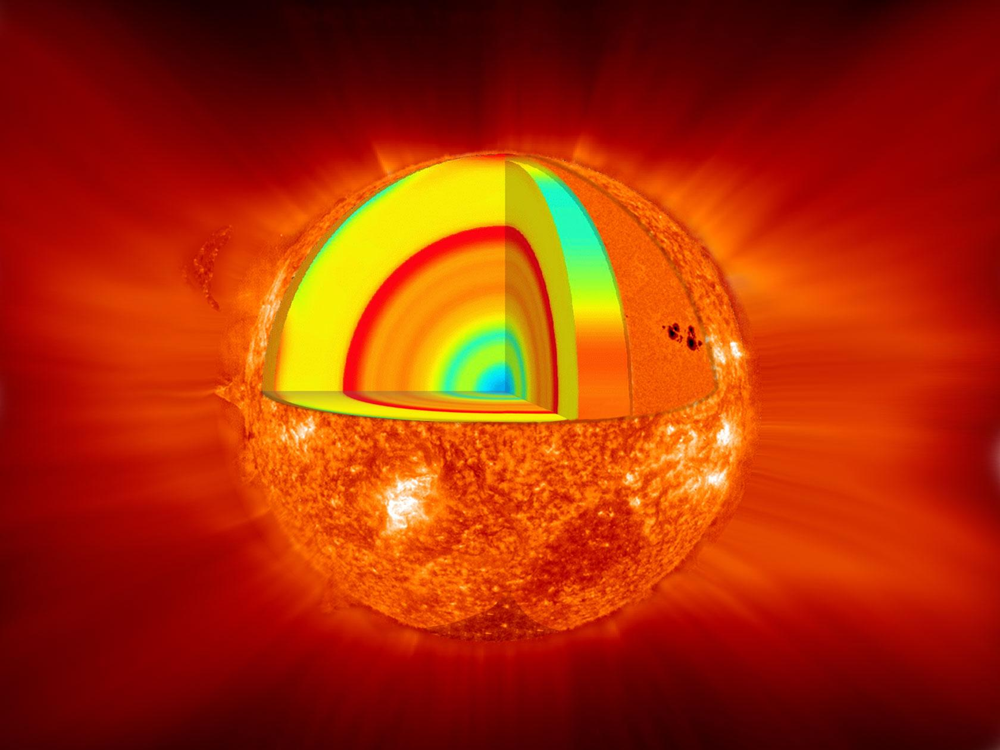
Deep inside the Sun, the core produces immense energy, which first travels outward through the radiative zone. By the time this energy reaches the bottom of the convection zone, it encounters gas that has cooled and become opaque enough that radiation is inefficient at carrying energy further. The result is a huge temperature difference: about 2 million °C at the base of the convection zone versus only about 5,700 °C at the surface. This steep gradient sets the stage for convection. You can picture it like a pot of water on a stove: the bottom (near the heat source) gets much hotter than the top, so the fluid begins to circulate. In the Sun, hot plasma (ionized gas) near the bottom of the convection zone becomes buoyant and rises upward, carrying heat. When it nears the surface, it cools (by radiating light into space) and thus becomes denser, causing it to sink back down deeper into the Sun. This cycle of rising and falling blobs of hot gas is continuous, forming convective cells – the solar plasma is literally boiling. Unlike a calm simmer, however, the solar convection zone is intensely turbulent: the flows are chaotic and constantly shifting, more like a rolling, roiling boil than a gentle churn.
Rotation adds another twist (literally) to how the convection zone operates. The Sun rotates once every ~27 days at the equator and more slowly (~32 days) near the poles, a phenomenon called differential rotation. Because the Sun is not solid, this uneven rotation causes convective flows to be deflected and twisted by the Coriolis effect. Convection cells in the Sun tend to swirl as they rise and sink, aligning into bands or vortices. This combination of turbulent convection and rotation turns the convection zone into a giant electromagnetic dynamo. The moving electrically charged plasma in this zone generates electric currents and magnetic fields, much like a dynamo generator turning mechanical motion into magnetism. In essence, the convection zone is where the Sun’s magnetic field is forged, through the interplay of convective motion and rotation – a process known as the solar dynamo.
Granulation: Evidence of Boiling Plasma
When you look at the Sun’s disk through a telescope equipped with a solar filter, you might notice that the surface isn’t uniform – it has a grainy texture. That texture is called solar granulation, and it’s direct evidence of the convection zone at work. Each granule on the Sun’s surface is the top of a convective cell. Hot plasma wells up in the center of a granule, appearing brighter, then spreads out and cools, sinking back down at the darker edges. The entire photosphere is covered with these granules, except where they are disrupted by sunspots. A typical granule is about 1,000 km across – roughly the size of Texas or France – and lasts only on the order of 10–20 minutes before breaking apart. New granules constantly form as old ones fade, giving the Sun’s surface a bubbling, ever-changing appearance. Granulation is literally the visible imprint of convection: you are seeing the tops of millions of rising and falling plasma cells.
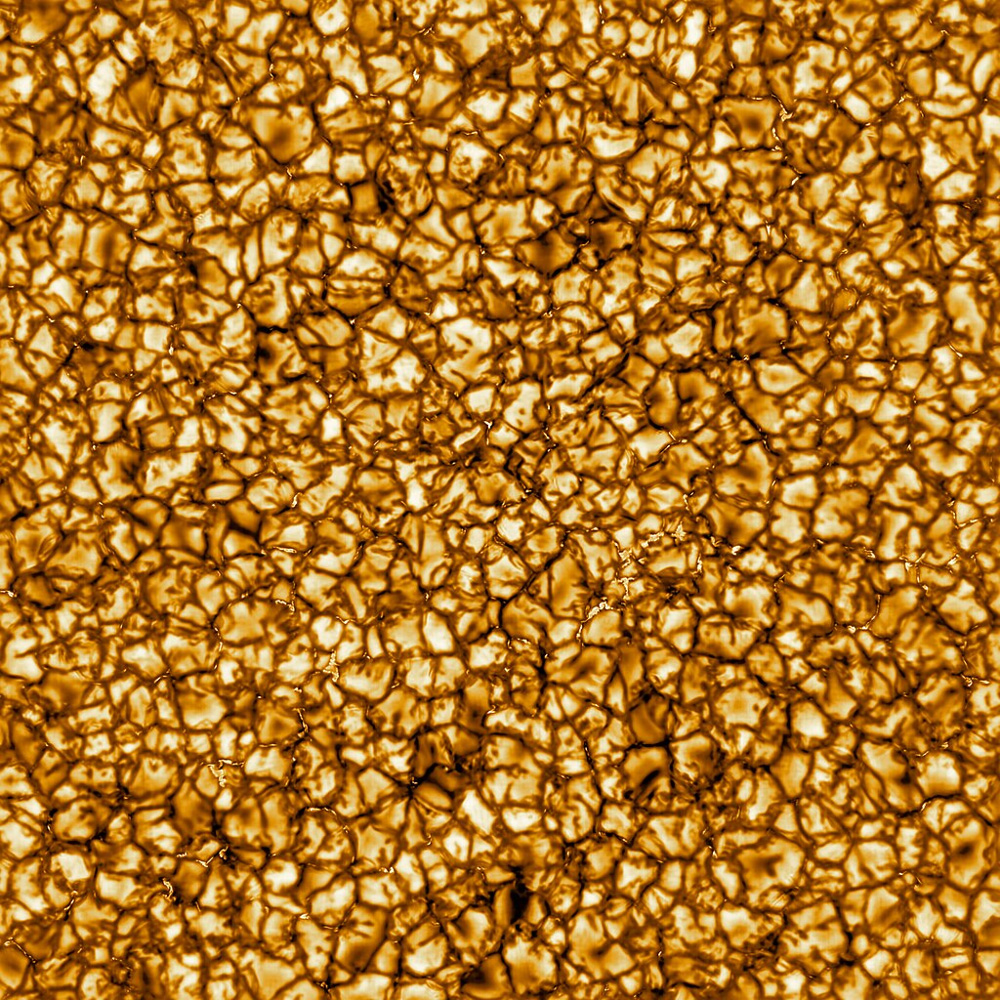
This high-resolution image shows a close-up of solar granulation – a “salt-and-pepper” pattern covering the Sun’s face. Bright cell centers mark where hot plasma is rising upward, and dark lanes trace the cooler plasma descending back into the Sun. At any given moment, around 4 million granules cover the Sun, each one a cell of convective flow. In addition to these small granules, there are larger convection-driven patterns called supergranules (~30,000 km across) that last a day or two. You won’t see supergranules in ordinary white-light images, but they can be detected by Doppler measurements of surface motion. Both granules and supergranules confirm that the Sun’s surface is the top of a boiling layer – a constantly overturning plasma “ocean” beneath the visible sunlight.
The Convection Zone’s Magnetic Role – Sunspots from Below
The convection zone doesn’t just move heat – it moves magnetic fields and even helps create them. The Sun’s plasma is electrically conductive, so as it swirls and flows, it drags magnetic field lines along. Over time, the differential rotation (faster at the equator than the poles) winds up and tangles these magnetic field lines within the convection zone. Think of it like taffy being stretched and twisted. The magnetic fields have some special properties in this environment: they tend to clump into concentrated bundles of field (flux tubes), and these bundles are buoyant – they are less dense than the surrounding plasma, so they rise through the boiling convective interior.
When a concentrated magnetic flux tube finally pushes its way up through the photosphere, it creates a sunspot. You’ve likely heard of sunspots as the dark patches that come and go on the Sun’s surface. Now you can appreciate why they form: a strong magnetic field bundle from underneath suppresses the normal convection in that area (imagine a knot in the boiling pattern). With hot plasma inhibited from rising, the region cools relative to its surroundings – and cooler means dimmer, so it appears dark. A sunspot’s dark core (umbra) might be about 4,000–4,300 °C, cooler than the ~5,800 °C photospheric surroundings. Sunspots can be enormous – often Earth-sized or larger – and usually come in bipolar pairs or groups that mark where the magnetic flux tube emerges and loops back beneath the surface. The magnetic nature of sunspots is well-established: they are regions of intense magnetic field, thousands of times stronger than Earth’s field.
It’s important to highlight that sunspots are not isolated surface phenomena; they are the visible “feet” of magnetic structures rooted in the convection zone. They appear and evolve as a direct consequence of the convection zone’s dynamics. In fact, if you watch the Sun over days and weeks, you’ll notice sunspots often emerge at certain latitudes and then drift, following patterns that repeat about every 11 years – this is the solar sunspot cycle. What you’re seeing is essentially the convective dynamo in action: the Sun’s magnetic field gets wound up and then reorders itself in a cycle. Approximately every 11 years, the magnetic field configuration flips (completing a 22-year magnetic cycle), and sunspot counts go from low (solar minimum) to high (solar maximum) and back down. Thus, the convection zone’s constant churning and the Sun’s rotation together drive the cyclical nature of solar magnetism.
From Convection to Solar Activity
Why should a stargazer care about these hidden convective motions? Because the convection zone is the hidden engine behind much of the Sun’s activity. The twisting, chaotic magnetic fields born in the convection zone don’t just create sunspots – they power a whole range of solar phenomena. When magnetic field lines become too twisted and stressed, they can suddenly reconfigure (magnetic reconnection), releasing tremendous energy. This energy powers solar flares and propels coronal mass ejections (CMEs) – explosive events that can hurl plasma into space. In other words, those active regions on the Sun (often centered on sunspot groups) are fueled by magnetic disturbances that originate in the convection zone’s dynamo. Prominences and coronal loops, the beautiful arcs of plasma visible in specialized filters, likewise trace out magnetic field lines that have their roots below the surface in the convection zone’s currents. The convection zone’s influence extends all the way up through the Sun’s atmosphere: for instance, the heating of the corona and the acceleration of the solar wind are believed to be linked to magnetic dynamics that start with convective motions.
To put it succinctly, the Sun’s convection zone is the driver of solar surface phenomena and space weather. Magnetic fields generated by the convection zone rise through the Sun’s surface and erupt into the solar atmosphere, resulting in the observed patterns of sunspots, flares, prominences, and CMEs. Every time you hear about a solar storm or see an image of a gigantic eruptive prominence, remember that it all ties back to that seething convection just below the Sun’s visible face.
In Conclusion: A Dynamic, “Boiling” Heart
You can now envision the convection zone as a vast, boiling layer of plasma beneath the Sun’s surface – hot gas rising, cooler gas sinking, all stirred by rotation, generating magnetic fields in the process. This vigorous movement is not abstract theory; it manifests right before your eyes as the Sun’s granulated surface and the evolving populations of sunspots. The convection zone plays an indispensable role in solar dynamics: it transports energy outward, it creates and amplifies the Sun’s magnetic field, and it sets the stage for the solar activity cycle. Far from being a static layer, it is a dynamic engine whose effects ripple upward to shape the Sun’s atmosphere and even influence Earth (via space weather and auroras).