
Mercury
Physical and Geological Features
Mercury is a small, rocky planet only about 38% of Earth’s diameter (≈2,440 km). Its mass is only 5.5% of Earth’s, yet it is extremely dense (5.43 g/cm³) – second only to Earth. You’ll learn that Mercury’s density comes from an oversized iron core. In fact, about 80% of Mercury’s radius is a metal core, giving it a strong gravitational pull for its size. The remaining silicate “shell” (mantle+crust) is very thin (~250–400 km thick). Observations suggest the core is partly molten even today, which helps generate Mercury’s magnetic field.
Mercury orbits very close to the Sun (average distance ~58 million km) on an eccentric (oval) path. Perihelion is about 46 million km and aphelion 70 million km. A single Mercury year (one orbit) is only 88 Earth days. Because Mercury spins much more slowly, its day (sunrise to sunrise) lasts about 176 Earth days. In fact, Mercury rotates three times on its axis for every two orbits it makes. This unusual 3:2 spin–orbit resonance means the Sun rises and sets very slowly; if you stood on Mercury at sunrise, it would take 88 days to reach noon!
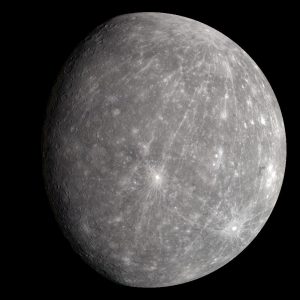
Mercury’s surface looks a lot like the Moon’s – covered in craters from billions of years of impacts. Huge basins stand out, especially the Caloris Basin (~1,550 km across) and other large craters (e.g. Rachmaninoff at 306 km). Between craters, there are smoother plains formed by ancient volcanic lava flows. These indicate Mercury was geologically active early on. A unique feature discovered by the MESSENGER mission is “hollows” – shallow, bright pits on crater floors or rims. These may form where volatile-rich rock sublimates away, leaving irregular depressions. Another distinctive terrain is the lobate scarps (cliffs hundreds of km long and up to 1 km high). These scarps were created when Mercury’s hot interior cooled and contracted, crumpling the crust.
You should also know Mercury has essentially no atmosphere. The gravity is too weak and the heat too intense to hold a real atmosphere. Instead, Mercury has a very thin exosphere of atoms that have been knocked off its surface by solar wind and micrometeorite impacts. Trace amounts of hydrogen, helium, oxygen, sodium, potassium, and other atoms exist briefly before being lost to space. Solar radiation pressure even pushes some of this gas into a faint “tail” stretching away from the Sun.
Because Mercury is so close to the Sun, its temperature range is extreme. Sunlit daytime areas can soar to about +430 °C, while nightside regions plunge to –180 °C. Only in permanently shadowed polar craters are temperatures low enough to trap ice. Radar studies (and later spacecraft) have indeed confirmed water ice and organic compounds in deep craters at Mercury’s poles. These icy patches are protected from sunlight, staying cold despite the blistering daytime heat.
Mercury has a global magnetic field, though very weak (about 1% the strength of Earth’s). This field is offset northward from the planet’s center and interacts strongly with the solar wind. Interestingly, magnetic “tornadoes” (flux-transfer events) can form, funneling solar plasma to the surface in localized jets. Your visits with spacecraft have shown that Mercury’s internal dynamics and magnetism are surprisingly rich topics of study.
Exploration History
Mercury has been visited by only a handful of spacecraft. The first was NASA’s Mariner 10, launched in 1973. Mariner 10 flew by Mercury three times in 1974–75, using Venus gravity assists to reach the inner solar system. It photographed nearly half of Mercury’s surface (including the first views of Caloris) and discovered the planet’s weak magnetic field. Mariner 10’s images revealed Mercury’s resemblance to the Moon – old, cratered terrain – and provided the first confirmation that Mercury does rotate (even if slowly).
Observing Mercury
You’ll find Mercury challenging to spot because it hugs the Sun. It never strays far from sunrise or sunset, so you must look very low on the horizon during twilight. In practice, Mercury is visible only shortly after sunset or before sunrise when it reaches its greatest elongation – the furthest angular separation from the Sun. These elongations occur roughly every 3–4 months. Best viewing comes when Mercury is about 18–28° from the Sun, placing it just 10–15° above the horizon in a clear sky.
Time your viewing
Look during astronomical twilight (about 30–60 minutes after sunset or before sunrise). If Mercury is east of the Sun, it will be an “evening star” after sunset; if west, it will appear before sunrise.
Altitude and clarity
Use a flat western (for evening) or eastern (for morning) horizon. An unobstructed view and good weather are essential, since Mercury never gets high in the sky.
Optical aid
Mercury shines as bright as about magnitude –0.5 at best, but its tiny disk is hard to see with the naked eye. Binoculars or a small telescope will help you spot it above nearby rooftops or trees. (Always be careful not to accidentally point equipment too close to the Sun!)
Phases
Through a telescope, Mercury shows phases like the Moon, from thin crescent to gibbous, which helps confirm you have the planet in view. Its phase changes rapidly as it orbits.