
centaurus
Welcome to the Centaurus Page!
The Centaurus constellation is situated in the southern hemisphere and belongs to the group of Greek constellations cataloged by the astronomer Ptolemy in the 2nd century. However, its earliest mentions can be traced back to the works of the astronomer Eudoxus and the poet Aratus. As one of the largest constellations in the night sky, Centaurus symbolizes the centaur—a legendary creature from Greek mythology that is half man and half horse. While there are varying accounts regarding which centaur the constellation represents, it is commonly associated with Chiron, the wise centaur known for mentoring heroes such as Hercules, Achilles, Theseus, and Perseus.
Centaurus is home to two of the ten brightest stars visible: Alpha Centauri and Beta Centauri. Additionally, it features the white dwarf star BPM 37093, affectionately known as Lucy or the Diamond Star. The constellation also boasts a variety of remarkable deep-sky objects, including Centaurus A, one of the brightest galaxies observable from Earth, and the globular cluster Omega Centauri. Among its noteworthy nebulae are the vibrant Running Chicken Nebula (IC 2944), the Blue Planetary Nebula or the Southerner, the protoplanetary Boomerang Nebula, and the Southern Crab Nebula, a symbiotic nebula.
FACTS
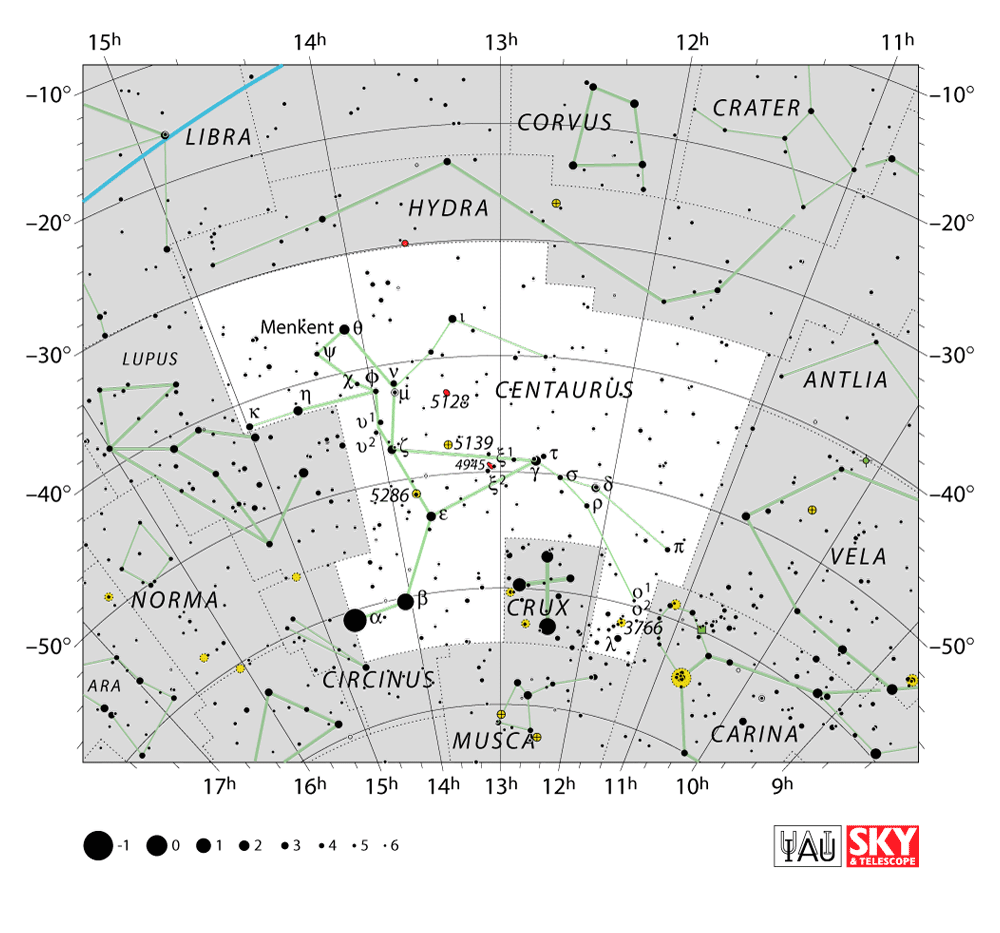
Centaurus is the ninth largest constellation, encompassing an area of 1,060 square degrees. Positioned in the third quadrant of the southern hemisphere (SQ3), it can be observed at latitudes ranging from +25° to -90°. It shares its celestial neighborhood with several constellations, including Antlia, Carina, Circinus, Crux, Hydra, Libra, Lupus, Musca, and Vela. The name Centaurus is pronounced /sɛnˈtɔːrəs/, and in English, it is often referred to as the Centaur. In star names, the genitive form is Centauri (pronounced /sɛnˈtɔːraɪ/), and the International Astronomical Union (IAU) designated the three-letter abbreviation “Cen” in 1922.
Within Centaurus, there are 11 stars known to host planets, though the constellation does not contain any Messier objects. The brightest star in Centaurus, Alpha Centauri, holds the title of the third brightest star in the entire night sky. Beta Centauri follows as the second brightest star in this constellation and ranks as the 11th brightest overall. Additionally, three meteor showers—the Alpha Centaurids, Omicron Centaurids, and Theta Centaurids—are associated with Centaurus.
The constellation boasts 12 named stars, which have received official approval from the IAU. These stars include Dofida, Hadar, Heng, Kulou, Leepwal, Matza, Menkent, Nyamien, Proxima Centauri, Rigil Kentaurus, Toliman, and Uklun.
MYTHOLOGY
The constellation Centaurus has ancient roots, tracing back to Babylonian astronomy where it was known as the Bison-man (MUL.GUD.ALIM). The Babylonians depicted this figure in two ways: either as a bison with a human head or a being with a human upper body connected to the hind legs of a bison or bull. They linked this creature to their Sun god, Utu (Shamash).
In Greek and Roman cultures, Centaurus came to be associated with centaurs—mythical beings that were part human and part horse. However, there is some ambiguity regarding which specific centaur this constellation represents. The Roman poet Ovid, writing around the dawn of the first millennium, suggested that it symbolized Chiron, the wise centaur known for training numerous legendary Greek heroes such as Achilles, Jason, Theseus, Heracles, and Asclepius, Apollo’s son who is associated with the constellation Ophiuchus. Other sources, however, connect Chiron more closely with the constellation Sagittarius, relegating Centaurus to represent one of the more unruly centaurs.
Chiron was born to the Titan king Cronus and the sea nymph Philyra. The tale goes that when Rhea, Cronus’ wife, unexpectedly arrived, he transformed himself into a horse to escape detection, resulting in Philyra giving birth to a hybrid child. Revered for his wisdom, Chiron excelled in teaching medicine, music, and hunting while living in a cave on Mount Pelion, where he mentored many young princes and future legends. Tragically, he met his end when he was accidentally struck by one of Heracles’ arrows, which had been poisoned with Hydra’s blood—an affliction that had no cure.
Despite being the offspring of the immortal Cronus, Chiron himself was immortal, and after being wounded, he endured immense suffering without being able to die. Eventually, Zeus took pity and freed Chiron from his immortality, allowing him to pass away, after which he was honored among the stars.
Centaurus is frequently illustrated as a centaur engaged in the sacrifice of an animal—represented by the constellation Lupus—on an altar represented by the constellation Ara. The centaur’s front legs are marked by two of the brightest stars in the night sky, Alpha and Beta Centauri, known as Rigil Kentaurus and Hadar, respectively.
Stars
Rigil Kentaurus, also known as Alpha Centauri (α Centauri), is a remarkable multiple star system located just 4.365 light years away from Earth. It boasts an impressive apparent magnitude of -0.27. The system’s brightest member, Alpha Centauri A, shines with a visual magnitude of -0.01, making it the fourth brightest star visible in the night sky, only a touch dimmer than Arcturus in the constellation Boötes. Notably, the combined luminosity of the Alpha Centauri system surpasses that of Arcturus.
Alpha Centauri A is a yellow-white main sequence star classified as G2V, and it is approximately 10% more massive than our Sun. Alongside it is Alpha Centauri B, another highly luminous star in this system. This star is classified as a K1V main sequence star, making it slightly smaller than the Sun. With an apparent magnitude of 1.33, Alpha Centauri B ranks as the 21st brightest star in the sky, marginally outshining Regulus in the constellation Leo.
Both Alpha Centauri A and B are believed to share a similar age of about 4.85 billion years, making them around 250 million years older than the Sun.
Proxima Centauri (Alpha Centauri C)
Within the Alpha Centauri system resides a third star known as Proxima Centauri, classified as a red dwarf. This star forms a visual pair with Alpha Centauri AB and is thought to be gravitationally linked to it. Designated as Alpha Centauri C, Proxima Centauri is located 2.2° from the binary star pair. It falls into the spectral category of M5Ve or M5Vie, indicating that it is either a small main sequence star or a sub-dwarf. With an estimated mass comprising only 12.3% that of our Sun, this star is predicted to remain in its main sequence phase for approximately four trillion years.
Proxima Centauri is notable for being the closest star to our solar system, situated just 4.24 light-years away. Despite this proximity, its apparent magnitude of 11.05 renders it invisible to the naked eye. Classified as a UV Ceti type flare star, Proxima Centauri can exhibit sudden fluctuations in brightness, varying between magnitudes of 11.0 and 11.9. The discovery of this star is credited to the Scottish-South African astronomer Robert Innes in 1915.
The Alpha Centauri system is also referred to by its traditional names, including Rigil Kentaurus, Rigil Kent, and Toliman. The name Rigil Kentaurus is derived from the Arabic term Rijl Qantūris, which translates to “the foot of the centaur,” while Toliman is thought to originate from the Arabic al-Zulmān, meaning “the ostriches.”
As the closest star system to our own, if there were observers residing in the Alpha Centauri system, they would perceive a sky largely akin to ours, albeit without the brightest star in the Centaurus constellation visible and with our Sun appearing as a magnitude 0.5 star in the Cassiopeia constellation.
Hadar
also known as Beta Centauri, is a blue-white giant star located approximately 348.83 light years from Earth. With an apparent magnitude of 0.6, it ranks as the tenth brightest star in our night sky and falls under the spectral class B1III. The name Hadar comes from an Arabic term meaning “ground,” while its alternate name, Agena, is derived from the Latin word for “the knee.”
Beta Centauri
is a binary star system, featuring a companion star that is separated from the brighter component by 1.3 arc seconds. The brighter star, known as Hadar A, is itself a spectroscopic binary consisting of two identical stars that orbit each other with a period of 357 days. At least one of these stars is classified as a Beta Cephei variable, characterized by fluctuations in brightness due to pulsations on its surface. Hadar B, the companion star, orbits around the binary pair, completing its orbit in a minimum of 250 years.
Menkent
designated as Theta Centauri (θ Centauri), is an orange K-type giant star classified under the spectral type K0IIIb. Situated about 60.9 light years away from Earth, it shines with an apparent magnitude of 2.06. The name Menkent comes from Arabic, translating to “shoulder of the Centaur,” and it is occasionally referred to as Haratan.
Gamma Centauri (γ Centauri)
is a binary star system consisting of two A0 spectral type stars, both exhibiting an apparent magnitude of 2.9. Located 130 light years away from our planet, the system boasts a combined apparent magnitude of 2.2. The two stars complete their orbit around one another approximately every 83 years. Historically, this system has been referred to as Muhlifain.
Epsilon Centauri (ε Centauri)
Epsilon Centauri is a blue-white giant star classified as B1III. It belongs to the Beta Cephei variable type, meaning it undergoes brightness fluctuations due to surface pulsations. With an average apparent magnitude of 2.29, its brightness varies slightly between magnitudes 2.29 and 2.31. This star is situated about 380 light-years from Earth.
Eta Centauri (η Centauri)
Eta Centauri is an extremely hot B-type dwarf star, possessing an age of less than 20 million years. It is categorized as a Be star due to its variable emission lines in the hydrogen spectrum. Additionally, it is classified as a Gamma Cassiopeiae type variable or shell star, characterized by its rapid rotation and the presence of a gas disc surrounding its equator. Eta Centauri rotates at an impressive speed of 310 kilometers per second, completing a rotation in less than a day. This star is located roughly 30 light-years away and has an apparent magnitude of 2.33.
Leepwal – Zeta Centauri (ζ Centauri)
Zeta Centauri is a spectroscopic binary star with an apparent magnitude of 2.55 and is approximately 382 light-years distant. It has a stellar classification of B2.5IV, indicating it is a hot blue subgiant star. The two stars in the system have an orbital period of 8.024 days. In 2024, the International Astronomical Union (IAU) officially designated the name Leepwal for Zeta Centauri, which is its traditional name in the Marshall Islands. Historically, this star was referred to as Alnair, derived from the Arabic phrase Nayyir Badan Qanṭūris, meaning “the bright star of the body of the Centaur.” Currently, the name Alnair is used for Alpha Gruis, the brightest star in the constellation Grus (the Crane).
Delta Centauri (δ Centauri)
Delta Centauri is classified as a Be star within the B2IVne category, and it is a Gamma Cassiopeiae type variable star. This celestial body is located around 395 light-years away, with a brightness that varies between magnitudes 2.51 and 2.65. The name Ma Wei is derived from the Chinese term Ma Wei san, which translates to “the Third Star of Horse’s Tail,” a designation referencing the asterism formed with G and Rho Centauri.
Heng – ν Centauri (Nu Centauri)
Nu Centauri, a blue-white subgiant of spectral type B2IV, is positioned roughly 475 light-years from our planet. Recognized as a Beta Cephei type variable star, it experiences fluctuations in brightness due to surface pulsations. Additionally, it is identified as a rotating ellipsoidal variable star, implying that it is part of a close binary system where the stars are elongated in shape, resulting in varying brightness as the visible light-emitting areas change. Among such stars, Spica, the most luminous in Virgo, stands out as the brightest rotating ellipsoidal star in our sky. Nu Centauri has an average apparent magnitude of 3.41, with brightness oscillating between magnitudes 3.38 and 3.41 over a period of 2.62 days.
κ Centauri (Kappa Centauri)
Kappa Centauri is a binary star system situated approximately 540 light-years away and classified as a B2IV type star. The more luminous component shines with an apparent magnitude of 3.13 and is a blue-white B-type subgiant. It has a spectroscopic companion located just 0.12 arc seconds from it. Kappa Centauri is also referred to by its Chinese name, Ke Kwan, which translates to “the Third Star of Imperial Guards,” deriving from the phrase Qí Guān sān.
BPM 37093
BPM 37093 is a white dwarf classified under the DAV4.4 spectral type. This variable star belongs to the DAV or ZZ Ceti class, characterized by pulsations typical for white dwarfs that possess a hydrogen-rich atmosphere, identifying it as a DA-type star. Its brightness varies due to non-radial gravity wave pulsations occurring within the star itself. Located about 53 light years from Earth, BPM 37093 has an apparent magnitude of 14.0.
Deep Sky Objects
Centaurus A (NGC 5128)
Centaurus A stands out as the fifth brightest galaxy visible from Earth and is one of the nearest radio galaxies to our solar system, situated between 10 and 16 million light-years away. Classified as either a lenticular or giant elliptical galaxy, it possesses an apparent magnitude of 6.84 and is thought to harbor a supermassive black hole at its core. Current theories suggest that Centaurus A is experiencing a collision with a spiral galaxy, which is contributing to an intense surge of star formation; over 100 regions of star birth have been identified within its disk. The galaxy also witnessed the spectacle of a type Ia supernova, SN 1986G, in 1986, marking the dramatic end of a white dwarf star. Centaurus A is the central member of its subgroup within the larger Centaurus A/M83 galaxy group, with Messier 83 (the Southern Pinwheel Galaxy) residing at the heart of another associated subgroup.
Omega Centauri (ω Centauri, NGC 5139)
Located about four degrees south of Centaurus A, Omega Centauri is a prominent globular cluster. With an apparent magnitude of 3.7 and a distance of approximately 15,800 light-years, it is one of the Milky Way’s largest and brightest globular clusters, visible to the naked eye. Initially documented as a star by the ancient astronomer Ptolemy, it was later recognized as a nebula by Edmond Halley in 1677, eventually classified as a cluster by John Frederick William Herschel in the 1830s. This cluster is composed of several million Population II stars, with an estimated age of around 12 billion years. Stars in its core are densely packed, located just 0.1 light-years apart. Notably, Kapteyn’s Star, a rapidly moving red dwarf in the constellation Pictor, is believed to have originated from Omega Centauri. Additionally, it is speculated that the cluster contains a central black hole and may have once formed the core of a dwarf galaxy that was assimilated by the Milky Way.
NGC 4945
Discovered by James Dunlop in 1826, NGC 4945 is a bright spiral galaxy situated about 11.7 million light-years away, making it the second brightest galaxy in the Centaurus A subgroup, with an apparent magnitude of 9.3. This galaxy features an energetic Seyfert II nucleus that could harbor a sizable black hole.
NGC 4650A
This polar-ring galaxy is located in Centaurus and possesses an apparent magnitude of 13.9, approximately 130 million light-years away. Polar-ring galaxies, characterized by an outer ring of stars and gas revolving around the galaxy’s poles, likely form due to gravitational interactions between galaxies or the collision of a smaller galaxy with a larger one’s disk. Only about 100 polar-ring galaxies are known.
The Blue Planetary Nebula (NGC 3918)
Often referred to as “The Southerner,” this bright planetary nebula is the most luminous in the southern sky. With an apparent magnitude of 8.5, it can be observed with a small telescope and is located about 4,900 light-years from Earth. Discovered by John Herschel in 1834, it is a striking example of stellar evolution.
NGC 4622
This face-on spiral galaxy is approximately 111 million light-years distant and has an apparent magnitude of 12.6. It is peculiarly known as the “backward galaxy” because its spiral arms lead in the direction of its rotation, which contrasts with the typical trailing spiral arms found in most spiral galaxies. Initially thought to showcase leading spiral arms, observations later confirmed that it houses a single inner trailing arm alongside two newly identified weak arms in its inner disk, which rotate in the opposite direction of the outer arms.
NGC 5090 and NGC 5091
This pair of colliding galaxies are in the midst of a merger, located about 150 million light-years from Earth. NGC 5090 is an elliptical galaxy associated with a strong radio source, while NGC 5091 is a spiral galaxy viewed edge-on and currently undergoing tidal disruption due to the ongoing interaction. They exhibit apparent magnitudes of 12.6 and 13.9, respectively.
NGC 4696
Positioned 150 million light-years away, NGC 4696 is an elliptical galaxy that ranks as the brightest within the Centaurus Cluster (A3526), a vast collection of hundreds of galaxies found in the Centaurus constellation. This galaxy has an apparent magnitude of 11.4 and is enveloped by several smaller dwarf elliptical galaxies.
NGC 5253
An irregular galaxy discovered by John Frederick William Herschel in 1787, NGC 5253 is approximately 10.9 million light-years from Earth and has an apparent magnitude of 10.3. It lies in the M83 subgroup and is marked by the observation of SN1972E, one of the most notable supernovae of the 20th century, which had an apparent magnitude of 8.5.
NGC 5408
Another irregular galaxy, NGC 5408 was also discovered by Herschel in 1834. Its relationship with the M83 subgroup is uncertain. This galaxy has an apparent magnitude of 12.2 and is situated about 15.7 million light-years from our planet.
NGC 4603
This spiral galaxy is noteworthy for containing over 36 Cepheid variable stars, making it one of the most distant galaxies known to host these type of stars. It has an apparent magnitude of 12.3.
NGC 5291
An interacting system of galaxies, NGC 5291 is surrounded by a collisional ring featuring young star-forming tidal dwarf galaxies, adding to the dynamic nature of this celestial grouping.