
Canis Major
Welcome to the Canis Major Page!
Canis Major is a constellation in the southern sky. Its name means “the greater dog” in Latin. Canis Major represents the bigger dog following Orion, the hunter in Greek mythology. The Great Dog is often depicted pursuing a hare, represented by the constellation Lepus. The smaller dog is represented by the nearby constellation Canis Minor.
Both dog constellations are among the 48 Greek constellations, first catalogued by Claudius Ptolemy of Alexandria in his Almagest in the 2nd century CE.
Canis Major is home to Sirius, the brightest star in the sky, and to the red hypergiant VY Canis Majoris, one of the largest stars known. The constellation also hosts several notable deep sky objects. These include the bright open clusters Messier 41, Caroline’s Cluster (NGC 2360), and the Tau Canis Majoris Cluster (NGC 2362), the colliding spiral galaxies NGC 2207 and IC 2163, the Canis Major Dwarf Galaxy, and the emission nebulae NGC 2359 (Thor’s Helmet Nebula) and Sh2-308 (the Dolphin Head Nebula).
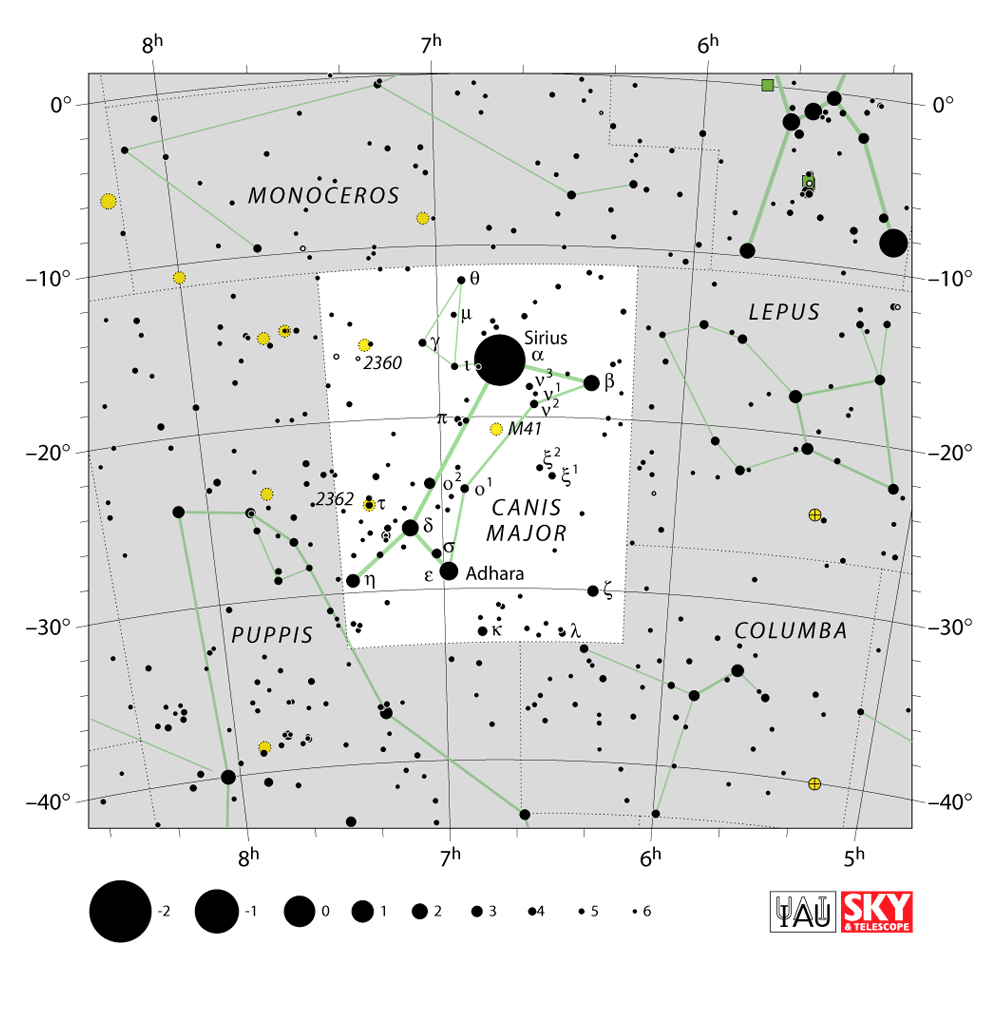
FACTS
Canis Major is the 43rd biggest constellation in the sky, occupying an area of 380 square degrees. It is located in the second quadrant of the southern celestial hemisphere (SQ1). The entire constellation can be seen from locations between the latitudes +60° and -90°. The neighboring constellations are Columba, Lepus, Monoceros, and Puppis.
The constellation name Canis Major is pronounced /ˈkeɪnɪs ˈmeɪdʒər/. In English, the constellation is known as the Great Dog. The genitive form of Canis Major, used in star names, is Canis Majoris (pronunciation: /ˈkeɪnɪs məˈdʒɒrɪs/). The three-letter abbreviation, adopted by the International Astronomical Union (IAU) in 1922, is CMa.
Canis Major belongs to the Orion family of constellations, along with Canis Minor, Lepus, Monoceros, and Orion. It is one of three dog constellations in the sky. The other two are Canis Minor (the Little Dog) and Canes Venatici (the Hunting Dogs).
The Canis Major constellation contains one Messier object, the star cluster Messier 41 (NGC 2287). There are no meteor showers associated with the constellation.
Sirius (Alpha Canis Majoris), the brightest star in Canis Major, is also the brightest star in the night sky. Popularly known as the Dog Star, Sirius shines at magnitude -1.47 from a distance of only 8.60 light-years.
The Great Dog hosts at least 10 stars with known planets: the orange giants Nu2 Canis Majoris, HD 47536 and HD 47366, the yellow dwarfs WASP-64 (Atakoraka), HATS-4, HD 45364, HD 45184 and HD 47186, the F-type star WASP-101, and the yellow or orange main sequence star or subgiant HD 43197 (Amadioha).
Canis Major contains 10 formally named stars. The star names approved by the International Astronomical Union (IAU) are Adhara (Epsilon Canis Majoris A), Aludra (Eta Canis Majoris), Amadioha (HD 43197), Atakoraka (WASP-64), Furud (Zeta Canis Majoris Aa), Mirzam (Beta Canis Majoris), Muliphein (Gamma Canis Majoris), Sirius (Alpha Canis Majoris A), Unurgunite (Sigma Canis Majoris), and Wezen (Delta Canis Majoris Aa).
The best time of the year to observe the stars and deep sky objects in Canis Major is during the month of February, when the constellation appears higher above the horizon around 9 pm.
MYTHOLOGY
Canis Major is commonly taken to represent the “greater dog” following the hunter Orion in Greek mythology. The constellation is depicted as a dog standing on its hind legs, pursuing a hare, represented by the constellation Lepus.
Canis Major was described by Manilius as “the dog with the blazing face” because the dog appears to hold Sirius, the brightest star in the sky, in its jaws.
In mythology, the constellation Canis Major is associated with Laelaps, the fastest dog in the world, one destined to catch anything it pursued. In Greek lore, Zeus gave Laelaps to Europa as a present, along with a javelin that could not miss. The gift proved to be an unfortunate one, as Europa herself met her end at the hands of her husband Cephalus, who was out hunting with the javelin.
Cephalus took the dog to Thebes in Boeotia (a Greek province north of Athens) to hunt down the Teumessian fox that was causing some trouble there. Like Laelaps, the fox was very fast and was destined to never be caught. Once the dog found the fox and started chasing it, the chase did not appear to have an end in sight.
In Greek myth, Zeus himself finally ended the chase and turned both animals to stone. He placed the dog in
Canis Major is one of the brighter constellations. It hosts Sirius, the brightest star in the night sky, and four second magnitude stars: Adhara, Wezen, Mirzam, and Aludra. These stars are visible even from light-polluted areas.
Sirius is found by extending a line through the three bright stars of Orion’s Belt. Mirzam appears close to the Dog Star in the sky, and Adhara, Wezen and Aludra form a prominent triangle southeast of Sirius.
Sirius is the only one of these stars that will not end its life as a supernova. Even though it has twice the Sun’s mass and is 25.4 times more luminous, the star appears so bright in Earth’s sky mainly because it is one of our nearest neighbours.
Adhara, Wezen, Mirzam, Aludra, and many other visible stars in Canis Major are supernova candidates. These massive stars have already evolved away from the main sequence, while Sirius is still fusing hydrogen into helium in its core. Due to its lower mass, Sirius will still be here long after these luminous giants and supergiants are gone.
Sirius – α Canis Majoris (Alpha Canis Majoris)
Sirius (α CMa), also known as the Dog Star, is the brightest star in the sky. It is the fifth nearest star system to the Sun, the seventh individual closest star, the nearest A-type star, and the second nearest visible star to Earth, after Alpha Centauri. It appears almost twice as bright as Canopus, the second brightest star in the sky, located in the constellation Carina.
Sirius is the brightest star in Canis Major, with an apparent magnitude of -1.46. It lies 8.60 light-years away. Procyon, the lucida of Canis Minor (the Little Dog) is likely its closest stellar neighbour. The two bright stars are separated by about 5.2 light-years.
Sirius is part of a binary system. It has a dim companion, a white dwarf star nicknamed the Pup, invisible to the unaided eye. Designated Alpha Canis Majoris B (or simply Sirius B), the stellar remnant is the nearest known white dwarf to the Sun. It has an apparent magnitude of 8.44.
Sirius, the brighter component in the system, is sometimes called Sirius A. It is a white main sequence star of the spectral type A0mA1 Va. It has a mass of 2.063 solar masses and a radius 1.711 times that of the Sun.
With an effective temperature of 9,940 K, Sirius is one of the hottest stars in the Sun’s neighbourhood. It shines with 25.4 solar luminosities and spins at 16 km/s. It has an estimated age of 242 million years.
Sirius B, the Pup Star, is a white dwarf of the spectral type DA2. It orbits Sirius A with a period of 50.1284 years at a distance that varies between 8.2 and 31.5 astronomical units.
Sirius B has a temperature of around 25,000 K. It is one of the most massive white dwarfs known. It has 101.8% of the Sun’s mass packed into a radius of 0.0084 solar radii, which is comparable to the radius of Earth. Like all stellar remnants, it is exceptionally dense. White dwarfs have a density about 200,000 times that of Earth.
Sirius B has an estimated age of 228 million years. Astronomers believe that it was once a hot, blue, B-type star with a mass 5 times that of the Sun. As the more massive star in the Alpha Canis Majoris system, it evolved faster than Sirius and passed through the red giant stage around 120 million years ago. Eventually it expelled its outer gaseous envelope and is now fading away as a white dwarf.
The name Sirius comes from the Greek Σείριος (Seirios), meaning “scorching,” “glowing” or “searing.” In ancient times, the star rose just before sunrise during the hottest summer period, the “dog days” of summer. Ancient Greeks and Romans believed that Sirius was somehow responsible for the summer heat.
In ancient Egypt, Sirius marked the flooding of the Nile. The star’s heliacal rising, just before the annual flooding and the summer solstice, played a crucial role in the Egyptian calendar during the Middle Kingdom era. Some suggest that ancient Egyptians associated Sirius with the god Osiris.