
Caelum
Welcome to the Caelum Page!
The small, faint constellation was originally named Caelum Sculptoris, the sculptor’s chisel. It is one of the 14 constellations created by the French astronomer Nicolas Louis de Lacaille in the 18th century.
Caelum does not contain any prominent deep sky objects and has only two stars brighter than fifth magnitude. The constellation’s brightest star, Alpha Caeli, shines at magnitude 4.456 and is difficult to see from light-polluted areas.
The constellation is home to the faint eclipsing binary star RR Caeli and the red dwarf LHS 1678, which hosts three exoplanets. Deep sky objects in Caelum include the unusual quasar HE0450-2958, notable for appearing to lack a host galaxy, and the galaxies NGC 1679, IC 2106, NGC 1570, the Carafe Group, and the Trekkie Galaxy (NGC 1701).
FACTS
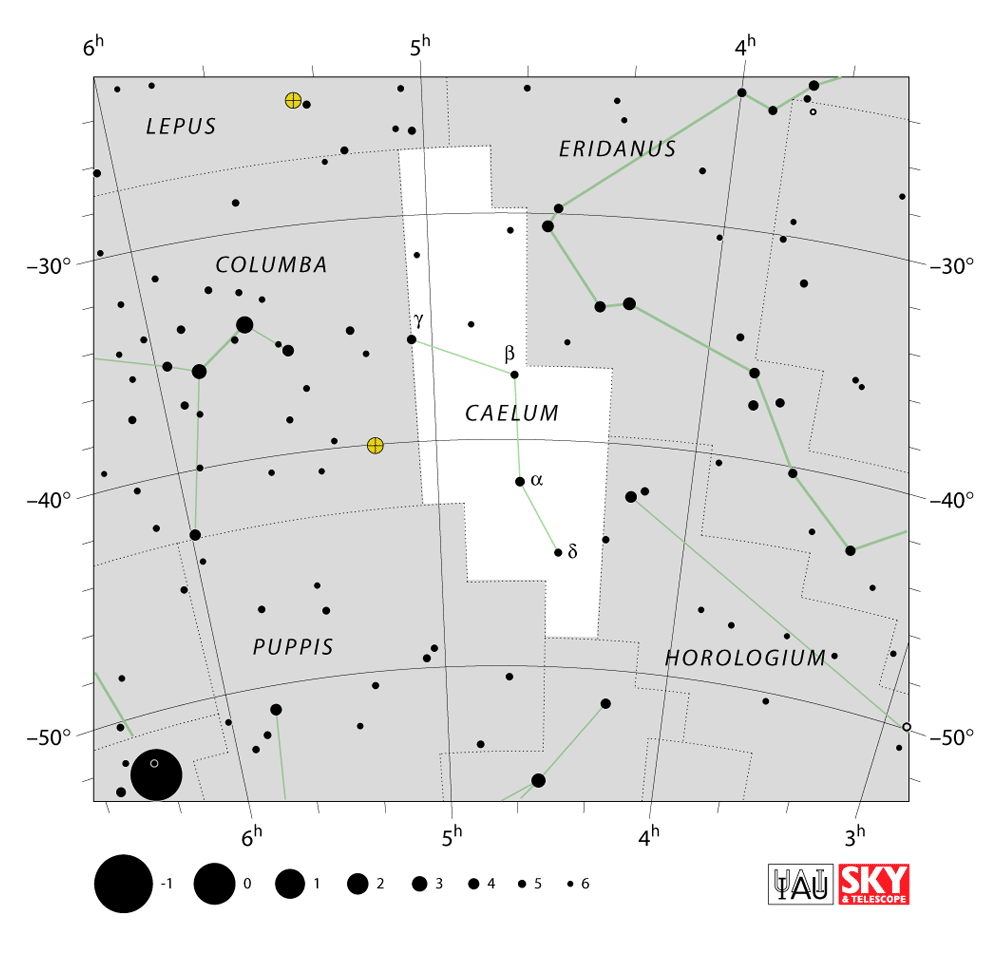
Caelum is the 81st largest (or the eighth smallest) constellation in the sky, occupying an area of only 125 square degrees of the southern sky. It lies in the first quadrant of the southern hemisphere (SQ1). The entire constellation can be seen from locations between the latitudes +40° and -90°
The neighboring constellations are Columba, Dorado, Eridanus, Horologium, Lepus, and Pictor
The constellation name Caelum is pronounced /ˈsiːləm/. In English, the constellation is known as the Engraving Tool or the Chisel. The genitive form of Caelum, used in star names, is Caeli (pronunciation: /ˈsiːlaɪ/). The three-letter abbreviation, adopted by the International Astronomical Union (IAU) in 1922, is Cae.
Caelum does not have any stars brighter than magnitude 3.00 or located within 10 parsecs (32.6 light years) of Earth.
The brightest star in Caelum is the yellow-white dwarf Alpha Caeli with an apparent magnitude of 4.456. The nearest star, the orange dwarf HD 30876, has the spectral class K2V and lies at a distance of 57.86 light years from Earth.
Caelum does not contain any named stars. There are no meteor showers associated with the constellation.
Caelum belongs to the Lacaille family of constellations, along with Antlia, Circinus, Fornax, Horologium, Mensa, Microscopium, Norma, Octans, Pictor, Reticulum, Sculptor, and Telescopium.
Caelum contains several stars with confirmed exoplanets. These include the eclipsing binary RR Caeli, the yellowish-orange dwarf HD 30669, and the F-type subgiant WASP-159 with one planet each, and the red dwarf LHS 1678 with three planets.
The best time of the year to see the constellation Caelum is during the month of January, when it appears higher above the horizon around 9 pm.
STORY
There are no myths associated with Caelum. Unlike the ancient constellations catalogued by Claudius Ptolemy in his Almagest, Caelum was not named after a mythological figure. It is one of the 14 constellations introduced by the French astronomer Lacaille in the 1750s. While the Latin word caelum also means “sky” or “heaven,” the small constellation is not associated with this meaning.
Lacaille named his constellations after various instruments and tools. The constellations introduced by the French astronomer include Antlia (the Air Pump), Circinus (the Compass), Horologium (the Pendulum Clock), Microscopium (the Microscope), Norma (the Level or the Carpenter’s Square), Octans (the Octant), and Telescopium (the Telescope).
Caelum is depicted as a sculptor’s chisel. It first appeared on Lacaille’s map of the southern stars published in 1756. The constellation was named “les Burins” and depicted as a pair of crossed burins – a standard burin and an échoppe – connected by a ribbon. (Burins are sharp engraving tools.) The name was translated into Latin as Caelum Sculptoris in Lacaille’s 1763 catalogue.
The name was shortened to Caelum by the English astronomer Francis Baily at the suggestion of the German-born British astronomer Sir William Herschel.