
Auriga
Welcome to the Auriga Page!
Auriga constellation lies in the northern hemisphere. Its name means “the charioteer” in Latin. The constellation got this name because its major stars form a shape similar to that of the pointed helmet of a charioteer. Auriga was first catalogued by the Greek astronomer Ptolemy in his Almagest in the 2nd century CE.
The constellation contains Capella, the sixth brightest star in the sky. It is also the site of the galactic anti-centre, the point in the sky opposite to the centre of the Milky Way Galaxy, which is located in the constellation Sagittarius, near the border with Scorpius. The nearest bright star to the galactic anti-centre is Elnath, Beta Tauri.
Auriga contains a number of interesting deep sky objects, including the open star clusters Messier 36, Messier 37, and Messier 38, the emission/reflection nebula IC 405 (the Flaming Star Nebula), and the protoplanetary Westbrook Nebula (CRL 618).
FACTS
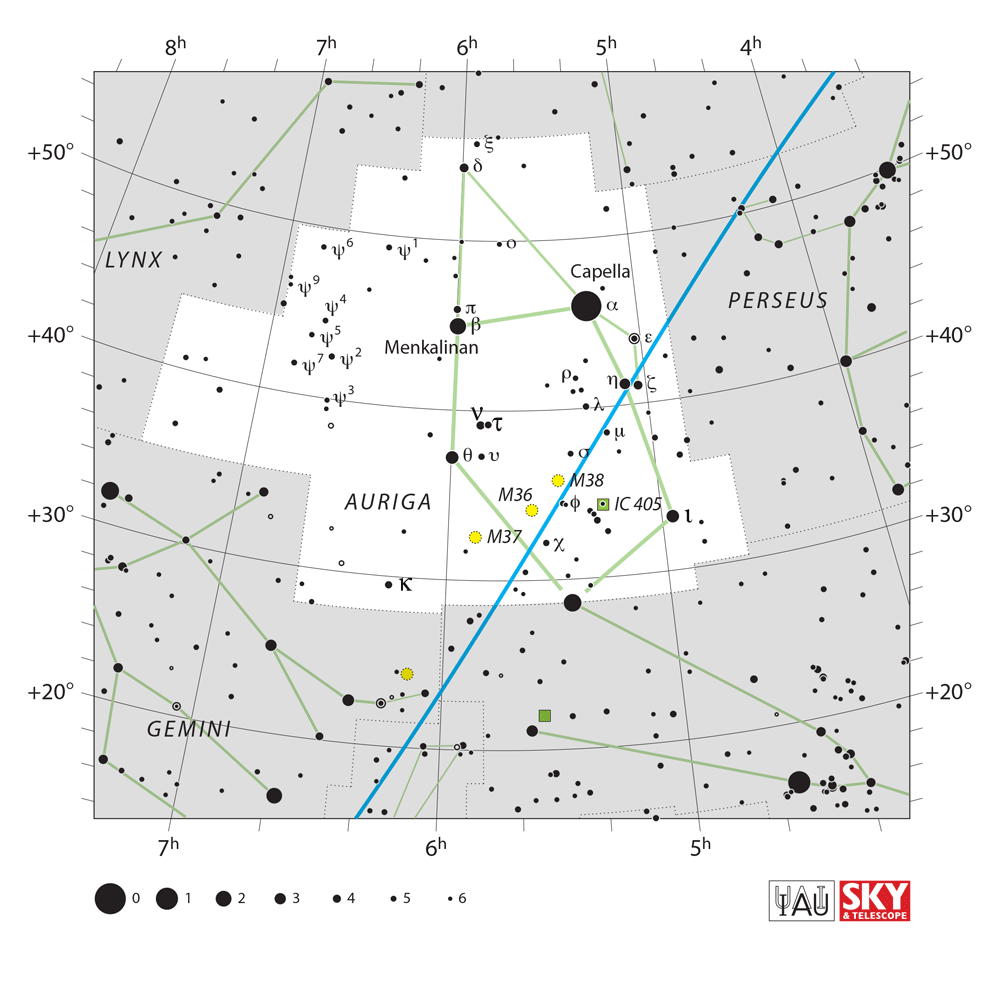
Auriga is the 21st largest constellation in the night sky. It stretches across 657 square degrees of the northern sky. It is located in the first quadrant of the northern hemisphere (NQ1). The entire constellation can be seen from locations between the latitudes +90° and -40°. The neighboring constellations are Camelopardalis, Gemini, Lynx, Perseus, and Taurus.
The brightest star in Auriga is Capella, Alpha Aurigae. Shining at magnitude 0.08 from a distance of 42.919 light-years, the yellow giant is the sixth brightest star in the sky.
The nearest star in Auriga is Gliese 268 (QY Aurigae), a binary system composed of two red dwarfs located 19.741 light-years away.
Auriga contains eight stars with known planets. These include the yellow dwarfs Nervia (HD 49674), WASP-12 and Lucilinburhuc (HD 45350), and the yellow-white dwarfs Tevel (HAT-P-9), HD 40979 and KELT-2.
The constellation contains 10 named stars. The star names approved by the International Astronomical Union (IAU) are Almaaz (Epsilon Aurigae A), Capella (Alpha Aurigae Aa), Haedus (Eta Aurigae), Hassaleh (Iota Aurigae), Lucilinburhuc (HD 45350), Mahasim (Theta Aurigae A), Menkalinan (Beta Aurigae Aa), Nervia (HD 49674), Saclateni (Zeta Aurigae A), and Tevel (HAT-P-9).
The best time of the year to observe Auriga is during the month of February, when the constellation appears higher above the horizon around 9 pm.
MYTHOLOGY
Babylonians identified Aries as the agrarian worker, the last stop on the ecliptic. The name of the constellation later changed to Ram, but why Babylonians changed it is uncertain. In the 7th century BC, Neo-Babylonians did a revision of the Babylonian zodiac that placed Alpha Arietis, Hamal, very close to the vernal equinox, which is how Aries came to be so prominent among the zodiac signs in astrology.
In those times, Aries contained the equinox, the point at which the Sun crosses the celestial equator from north to south. Because of precession (slow wobble of Earth’s axis), the vernal equinox is no longer in Aries, but in Pisces. In 130 BC, however, it was located just south of Gamma Arietis (Mesarthim) and was taken to be the starting point of the zodiac.
Auriga is usually depicted as a charioteer, holding the reins of a chariot with his right hand and carrying a goat and its two young on his left arm. Even though the image of the charioteer appears in Johann Bode’s Uranographia (1801), none of the stories Auriga is usually associated with have a goat in them.
In mythology, Auriga is most frequently identified with Erichthonius, king of Athens and son of the fire god Hephaestus.
Erichthonius was raised by the goddess Athena, who taught him many skills he wouldn’t have ordinarily learned. He was the first man to tame and harness four horses to a chariot, imitating the chariot of the Sun god. Zeus was impressed and later placed Erichthonius among the stars. Erichthonius is usually credited for the invention of the four-horse chariot, the quadriga.
In another myth, Auriga represents Hephaestus himself, the lame god, who built the chariot so that he could travel anywhere he wanted, whenever he wanted, without difficulty.
In another popular myth, the charioteer is Myrtilus, son of Hermes, who served King Oenomaus of Pisa. Oenomaus had a beautiful daughter, Hippodamia, and was determined not to give her hand away to any of her suitors. He would challenge each of them to a chariot race. If he caught up with them before they arrived to Corinth, they would meet their end at his hands.
With Myrtilus driving the king’s chariot, none of Hippodamia’s suitors survived the race until Pelops, son of Tantalus, came to ask the king for his daughter’s hand. Hippodamia fell in love with Pelops at first sight and asked Myrtilus to let him win. The charioteer, who was himself in love with the king’s daughter, obeyed and tampered with the chariot’s wheels. During the race, the wheels fell off and King Oenomaus was thrown off the chariot and did not survive. Once Pelops had won the race, he cast his rival Myrtilus into the sea. Betrayed, Myrtilus cursed the house of Pelops before he drowned. It was Myrtilus’ father Hermes who placed his son’s image among the stars.
The star Capella, Alpha Aurigae, is associated with Amalthea, the goat who was foster-mother to Zeus. The name Capella is Roman and means “she-goat.” The star is located on the Charioteer’s left shoulder..