
Canes Venatici
Welcome to the Canes Venatici Page!
Canes Venatici constellation lies in the northern hemisphere. The constellation’s name means “hunting dogs” in Latin. Canes Venatici represents the hunting dogs of Boötes, the Herdsman, represented by the neighboring constellation. The two hunting dogs are known as Asterion and Chara.
The Greek astronomer Ptolemy included the stars of Canes Venatici in the constellation Ursa Major as informes (unformed stars), but the constellation was not introduced until 1687, when the Polish astronomer Johannes Hevelius created it from the faint stars located under the Great Bear’s tail.
Canes Venatici contains the famous stars Cor Caroli and La Superba and a number of interesting deep sky objects. These include the Messier galaxies known as the Whirlpool Galaxy (M51), Sunflower Galaxy (M63), Cat’s Eye Galaxy (M94) and Messier 106, the globular cluster Messier 3, the Whale Galaxy (NGC 4631), the Heron Galaxy (NGC 5394 and NGC 5395), the Hockey Stick Galaxy (NGC 4656 and NGC 4657), and the Cocoon Galaxy (NGC 4490).
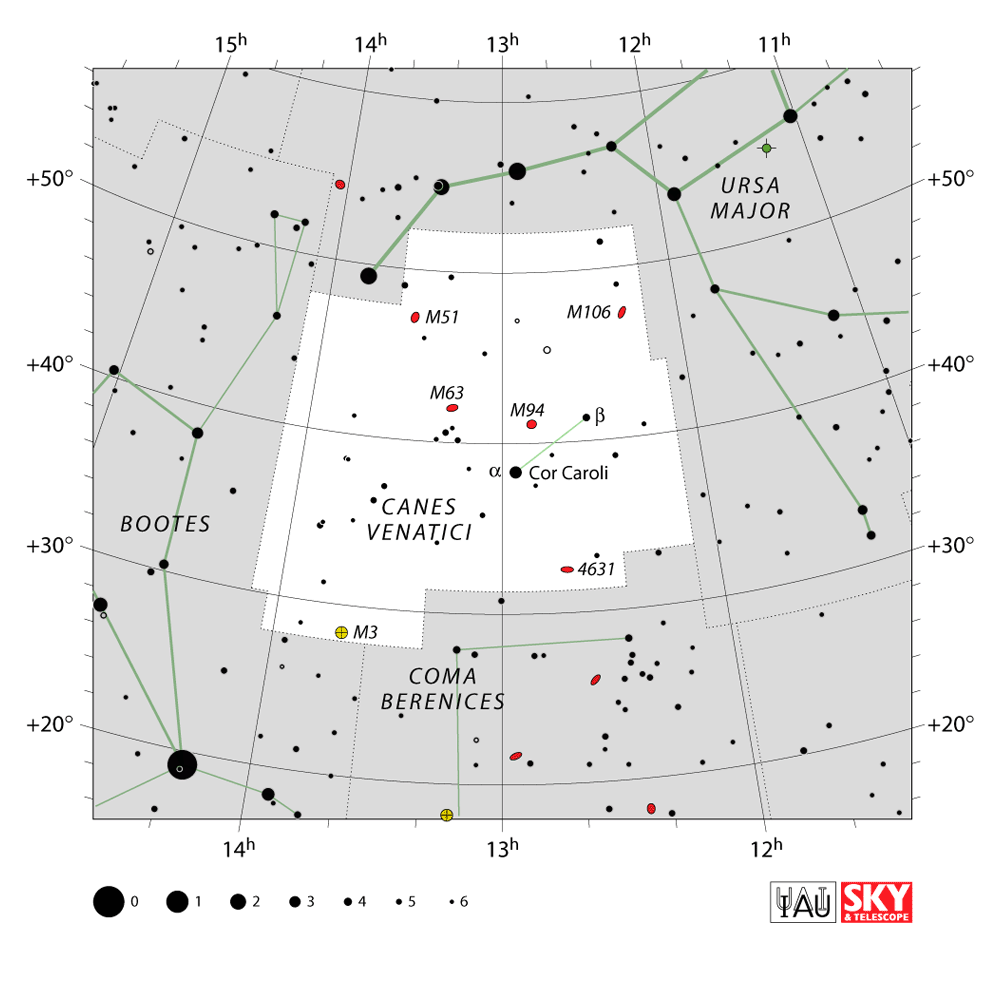
FACTS
Canes Venatici is the 38th largest constellation in the sky, occupying an area of 465 square degrees.
It is located in the third quadrant of the northern hemisphere (NQ3) and can be seen at latitudes between +90° and -40°. The neighboring constellations are Boötes, Coma Berenices, and Ursa Major.
The constellation name Canes Venatici is pronounced /ˈkeɪniːz vɪˈnætɪsaɪ/. In English, the constellation is known as the Hunting Dogs. The genitive form of Canes Venatici, used in star names, is Canum Venaticorum (pronunciation: /ˈkeɪnəm vɪnætɪˈkɒrəm/). The three-letter abbreviation, adopted by the International Astronomical Union (IAU) in 1922, is CVn.
Canes Venatici has only one star brighter than magnitude 3.00 and two stars located within 10 parsecs (32.6 light years) of Earth. The brightest star in Canes Venatici is Cor Caroli, Alpha Canum Venaticorum. The nearest star, DG Canum Venaticorum (spectral class M4.0Ve), is only 25.89 light years distant from Earth. The constellation has four stars with known planets.
Cor Caroli is the brightest star in the constellation, with an apparent magnitude varying between 2.84 and 2.98. It is approximately 110 light years distant. Its name means “Charles’ heart.”
The star was named by Sir Charles Scarborough, mathematician and physician to Charles II, in honour of Charles I, the king who met his end after the English Civil War, whose son was restored to the throne shortly after his passing. Alpha CVn was originally named Col Caroli Regis Martyris.
Cor Caroli is a binary star composed of two stars separated by 19.6 arcseconds in the sky. The brighter component, Alpha-2 CVn, is a chemically peculiar star that belongs to the spectral class A0 and is classified as an Ap/Bp star (one showing an overabundance of certain metals). The star has an unusually strong magnetic field, one 5,000 times as strong as the Earth’s, and its atmosphere has overabundances of europium, mercury and silicon.
Cor Caroli is the brightest star in the constellation, with an apparent magnitude varying between 2.84 and 2.98. It is approximately 110 light years distant. Its name means “Charles’ heart.”
The star was named by Sir Charles Scarborough, mathematician and physician to Charles II, in honour of Charles I, the king who met his end after the English Civil War, whose son was restored to the throne shortly after his passing. Alpha CVn was originally named Col Caroli Regis Martyris.
Cor Caroli is a binary star composed of two stars separated by 19.6 arcseconds in the sky. The brighter component, Alpha-2 CVn, is a chemically peculiar star that belongs to the spectral class A0 and is classified as an Ap/Bp star (one showing an overabundance of certain metals). The star has an unusually strong magnetic field, one 5,000 times as strong as the Earth’s, and its atmosphere has overabundances of europium, mercury and silicon.
La Superba is a well-known star in Canes Venatici and one of the reddest stars in the sky. It was named La Superba by 19th century Italian astronomer Angelo Secchi because of its striking appearance.
The star is believed to be in the last stages of fusing its secondary fuel, helium, into carbon. It is losing mass at a relatively fast rate and is surrounded by a disk of ejected material. Most likely, Y CVn will eject its outer layers (relatively) soon to form a nebula and become a white dwarf.
La Superba is a semi-regular variable star, with an apparent magnitude varying between 4.8 and 6.3 over a period of 160 days. It is the brightest J-star known. (J-stars are the rare carbon stars that contain an abundance of carbon-13.) The star lies about 711 light years from Earth.
AM CVn is classified as a cataclysmic variable star, one that irregularly has dramatic increases in luminosity and then drops back to a quiescent state. Cataclysmic variables are typically binary stars, composed of a white dwarf and a mass transferring secondary star. The gravity of the white dwarf distorts the other star and the white dwarf accretes matter from it. The material falling from the donor star usually forms an accretion disc around the white dwarf.
AM CVn is a prototype of a class of variables known as the AM CVn stars. These stars are cataclysmic variables consisting of two white dwarfs, with the accretion disc composed mainly of helium. The stars are also interesting as a source of gravitational waves.
AM Canum Venaticorum has an apparent magnitude of 14.18 and is approximately 2,000 light years distant.
RS Canum Venaticorum is another star in Canes Venatici that serves as a prototype for a class of variable stars. The RS Canum Venaticorum variables are close binary stars with variations in luminosity caused by the stars’ active chromospheres. The period of variations typically mirrors the orbital period of the star system. The stars’ luminosity typically fluctuates by 0.2 magnitudes.
Canes Venatici contains five Messier objects: M3 (NGC 5272), the Whirlpool Galaxy (M51, NGC 5194, NGC 5195), the Sunflower Galaxy (M63, NGC 5055), M94 (NGC 4736), and M106 (NGC 4258). There is a meteor shower associated with the constellation, the Canes Venaticids, taking place in January.
Canes Venatici contains five named stars. The star names approved by the International Astronomical Union (IAU) are Chara, Cor Caroli, Komondor, La Superba, and Tuiren.
Canes Venatici belongs to the Ursa Major family of constellations, along with Boötes, Camelopardalis, Coma Berenices, Corona Borealis, Draco, Leo Minor, Lynx, Ursa Major, and Ursa Minor.
STORY
In the Middle Ages, Canes Venatici was identified with the two dogs held on a leash by Boötes, the Herdsman, because there was a mistake in the translation of Ptolemy’s Almagest from Greek to Arabic.
In Ptolemy’s text, some of the stars in Boötes represent the Herdsman’s club. The translator loosely translated the Greek word for “club” (Κολλοροβος ) as “the spearshaft with a hook” (“al-`aşā dhāt al-kullāb”). When the Arabic phrase he used was later translated to Latin, the translator mistook one of the words for kilāb, which means “dogs.”
Boötes was depicted with two dogs in 1533 on a map by the German astronomer Peter Apian, and Hevelius decided to define the dogs’ position in the night sky in the 17th century. Hevelius named the northern dog Asterion (“little star” in Greek) and the southern one Chara (“joy”). The name Chara later started to be used specifically to refer to the star Beta CVn.