
Carina
Welcome to the Carina Page!
Carina constellation is located in the southern sky. Its name means “the keel” (keel of a ship) in Latin. Carina used to be part of the much larger constellation Argo Navis, along with the constellations Puppis (the stern) and Vela (the sails). The constellation represented the mythical ship Argo, on which Jason and the Argonauts sailed to get the Golden Fleece.
Argo Navis was first catalogued by the Greek astronomer Ptolemy in the 2nd century CE. It was the French astronomer Nicolas Louis de Lacaille who divided it into the three smaller constellations – Carina, Puppis and Vela – in the 18th century. The three smaller constellations were added to the official list of the modern constellations in the early 20th century, when the International Astronomical Union (IAU) defined the constellation borders on the celestial sphere.
Carina contains the second brightest star in the night sky, Canopus, along with several other notable bright stars, among them Eta Carinae, surrounded by the famous Carina Nebula. Other famous deep sky objects in the constellation include the Theta Carinae Cluster (Southern Pleiades), the Wishing Well Cluster, the Southern Beehive Cluster (NGC 2516), the open cluster NGC 3603, and the Statue of Liberty Nebula (NGC 3576).
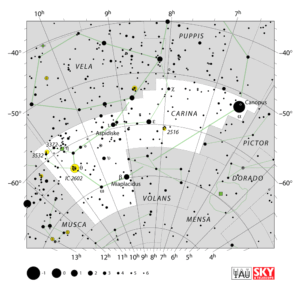
FACTS
Carina is the 34th largest constellation in the sky, occupying an area of 494 square degrees. It lies in the second quadrant of the southern hemisphere (SQ2) and can be seen at latitudes between +20° and -90°. The neighboring constellations are Centaurus, Chamaeleon, Musca, Pictor, Puppis, Vela, and Volans.
The constellation name Carina is pronounced /kəˈraɪnə/. In English, the constellation is known as the Keel. The genitive form of Carina, used in star names, is Carinae (pronunciation: /kəˈraɪniː/). The three-letter abbreviation, adopted by the International Astronomical Union (IAU) in 1922, is Car.
Carina belongs to the Heavenly Waters family of constellations, along with Columba, Delphinus, Equuleus, Eridanus, Piscis Austrinus, Puppis, Pyxis, and Vela.
Carina is home to 11 stars with known planets and does not contain any Messier objects. The brightest star in the constellation is Canopus, Alpha Carinae, with an apparent magnitude of -0.74. There are two meteor showers associated with the constellation: the Alpha Carinids and the Eta Carinids.
Carina contains six named stars. The star names approved by the International Astronomical Union (IAU) are Aiolos (HD 95086), Aspidiske (Iota Carinae), Avior (Epsilon Carinae A), Canopus (Alpha Carinae A ), Miaplacidus (Beta Carinae), and Tapecue (HD 63765).
Mythology
Carina by itself is not associated with any myth in particular, but the larger constellation to which it once belonged – Argo Navis – represented the ship on which Jason and the Argonauts sailed to Colchis (western part of present-day Georgia, on the Black Sea) to get the Golden Fleece.
Argo Navis was one of the 48 constellations known to the Greeks and catalogued by Ptolemy in his Almagest. It occupied a vast area of space between the constellations Canis Major and Crux (the Southern Cross).
The constellation Pyxis (compass), created from stars that used to form the constellation Malus, which represented the ship’s mast in ancient times, was added near the ship later.
Carina represents the main body of Argo Navis and the star Canopus marks the blade on one of the ship’s steering oars.
The ship was named after its creator Argus, who built it under the orders of Athena, using timber from Mount Pelion. Athena fitted the ship with an oak beam from the oracle of Zeus at Dodona, believed to be the oldest Hellenic oracle. The oak beam, as the myth goes, was able to speak because it was part of an oracle.
When the ship was built, Jason and the Argonauts – 50 greatest Greek heroes, among them Heracles, Orpheus and the twins Castor and Polydeuces – set sail to Colchis. On the way, they faced the Clashing Rocks (Symplegades) that guarded the entrance to the Black Sea and crushed all ships that passed between them. Argo Navis was said to be the first ship that passed between them and stayed in one piece. Once in Colchis, Jason and the Argonauts took the Golden Fleece from King Aeëtes and went back to Greece, where Jason beached the ship at Corinth and dedicated it to the sea god Poseidon.
Centuries later, Sir Isaac Newton suggested that the voyage of Argo Navis was commemorated in the sky in the 12 signs of the zodiac, but the connections are not quite obvious.
In another myth, the star Canopus was named after King Menelaus’ helmsman Canopus, who met his end after being bitten by a snake in Egypt when Menelaus’ fleet, driven by a storm, landed there on the way back from Troy. Menelaus buried his helmsman with full honours and the site of Canopus’ grave became a city named after him, located at the mouth of the Nile. (The city is the present-day Abu Qir.)
Notable Stars and Deep Sky Objects in Carina
Canopus (Alpha Carinae)
Canopus, designated Alpha Carinae, reigns as the second brightest star in the night sky—outshone only by Sirius. It is a constant presence for those located south of latitude 37°18’, never dipping below the horizon. Conversely, observers situated north of this latitude will never see Canopus rise, making it invisible from higher northern latitudes.
Spectroscopically, Canopus is an F-type bright giant. With an apparent magnitude of –0.74 and an imposing absolute magnitude of –5.53, this star radiates 13,600 times the Sun’s light. Canopus sits at a distance of about 310 light years and is the most luminous star within 700 light years of the Sun.
The star’s name is rooted in ancient legend—a Latinized form of the Greek “Kanôbos” from Ptolemy’s Almagest, referencing the fabled pilot for Menelaus on his journey to Troy. In Arabic traditions, Canopus is called “Suhail” (with variant spellings), a name it shares with other prominent southern stars. The Chinese recognize Canopus as the “Star of the Old Man,” linked in Taoist culture to longevity and happiness, personified as the Old Man of the South Pole.
Canopus is a member of the Scorpius-Centaurus OB association, a cluster of hot, massive stars that share a common origin and motion. This stellar family also includes such notables as Antares and other bright stars across Scorpius, Centaurus, Crux, and Lupus.
Eta Carinae (η Carinae)
Eta Carinae is not a single star, but a complex stellar system roughly 7,500 to 8,000 light years away. This system’s combined luminosity reaches a staggering four million times that of the Sun. The primary component is among the most massive stars known, tipping the scales at over 100 solar masses. Eta Carinae goes by several traditional names, including Tseen She (Chinese, “heaven’s altar”) and Foramen.
Classified as a luminous blue variable (LBV) and a Wolf-Rayet (WR) type binary, Eta Carinae defies easy categorization. It is circumpolar for observers south of 30°S and never rises for those north of 30°N. Edmond Halley catalogued it in 1677 at fourth magnitude; by 1843, it surged to rival Sirius in brightness, only to fade once again.
Eta Carinae is infamous for its titanic eruptions, most notably the mid-19th century outburst that created its signature bipolar Homunculus Nebula. These violent events briefly elevated the star to supernova-like brightness, although the star itself survived. The physical processes driving these eruptions remain a subject of active research. Eta Carinae remains an X-ray source and is closely monitored for future outbursts or the inevitable supernova or hypernova event—an explosion that may one day impact Earth’s upper atmosphere and technology, despite the protective buffer of distance and our own magnetosphere.
Miaplacidus (Beta Carinae)
Beta Carinae, or Miaplacidus, is the constellation’s second-brightest beacon and the 29th brightest star overall, shining at magnitude 1.67 from 111 light years away. Its name blends Arabic and Latin to mean “placid waters.”
Miaplacidus is an A-type subgiant and marks one corner of the Diamond Cross asterism, together with Theta, Upsilon, and Omega Carinae. This distinctive asterism graces the southern sky below latitude 20°N. Nearby lies the elliptical planetary nebula IC 2448, a subtle but fascinating deep sky companion.
Avior (Epsilon Carinae)
Epsilon Carinae, known as Avior, ranks as the constellation’s third brightest star (magnitude 1.86, distance 630 light years). Avior is a double star system: the primary is a K0 III orange giant nearing the end of its stellar life, while its companion is a B2 V blue dwarf. The two eclipse each other regularly, causing minor but measurable changes in their combined brightness.
The name Avior is a 20th-century invention, assigned in the late 1930s when navigational needs required unique names for RAF reference stars.
Aspidiske (Iota Carinae)
Iota Carinae, also called Aspidiske, Turais, or Scutulum (all referencing “shield”), is an A8 Ib white supergiant. It shines at magnitude 2.21 from a distance of about 690 light years. With a luminosity nearly 5,000 times the Sun’s and an estimated age of 40 million years, it stands as a rare, young supergiant. Aspidiske forms part of the False Cross asterism, a familiar navigation hazard in the southern hemisphere for its deceptive resemblance to the true Southern Cross (Crux).
Theta Carinae
Theta Carinae is a blue-white B0Vp main sequence star and the dominant member of the open cluster IC 2602, known as the Southern Pleiades for its likeness to the famed Pleiades cluster. Theta Carinae is found 439 light years away and shines at magnitude 2.74, anchoring the northeast corner of the Diamond Cross.
Upsilon Carinae
Upsilon Carinae is a double star system comprising a white A-type supergiant and a blue-white B-type giant, separated by 5 arcseconds. Their magnitudes are 3.01 and 6.26, with the system located 1,623 light years distant.
Omega Carinae
Omega Carinae, another member of the Diamond Cross, is a blue-white B-type giant with a magnitude of 3.29 and lies 370 light years away.
Additional Noteworthy Stars
AG Carinae – A luminous blue variable, AG Carinae is among the Milky Way’s most radiant stars, with brightness varying from magnitude 5.7 to 9.0. It is about 6,000 light years distant and is enveloped by a substantial planetary nebula.
PP Carinae – A blue-white B-type main sequence star, 497 light years away. It is a shell star and a Gamma Cassiopeiae-type variable.
V337 Carinae – K-type bright giant and variable, magnitude ranges from 3.36 to 3.44, 740 light years distant.
V357 Carinae – A spectroscopic eclipsing binary, average magnitude 3.43, at 419 light years. The system consists of two B-type subgiants with a short orbital period.
Chi Carinae (χ Carinae) – A blue-white subgiant, 387 light years away. It is a Beta Cephei-type variable, fluctuating subtly every 2.4 hours.
I Carinae (HD 84810) – A yellow G-type supergiant, 1,510 light years distant. It is a Cepheid variable, with its brightness varying over a 35-day cycle.
V382 Carinae – A yellow G-type hypergiant and Cepheid variable about 5,930 light years away, with immense physical size and luminosity.
V533 Carinae – A white A-type supergiant, 4,000 light years distant, classified as an Alpha Cygni-type variable.
Deep Sky Highlights in Carina – Carina Nebula (NGC 3372, Eta Carinae Nebula)
The Carina Nebula is a vast star-forming region, home to several massive stars—including Eta Carinae and HD 93129A—and multiple open clusters. It dwarfs the more familiar Orion Nebula, measuring over 260 light years across and glowing with an apparent magnitude of 1.0, though it is best viewed from southern latitudes.
The nebula, which lies between 6,500 and 10,000 light years away, contains some of the Galaxy’s rare O-type stars. French astronomer Nicolas Louis de Lacaille discovered it in the 1750s from the Cape of Good Hope. Within its expanse are the bipolar Homunculus Nebula, formed by Eta Carinae’s 19th-century outburst, and the Keyhole Nebula, a small, dark cloud silhouetted against the brighter backdrop.