
Cassiopeia
Welcome to the Cassiopeia Page!
Cassiopeia is located in the northern sky. It was named after Cassiopeia, the vain and boastful queen in Greek mythology..
The constellation contains several notable deep sky objects, among them the open clusters Messier 52 and Messier 103, the Heart Nebula and the Soul Nebula, the supernova remnant Cassiopeia A, the star-forming cloud popularly known as the Pacman Nebula, and the White Rose Cluster.
FACTS
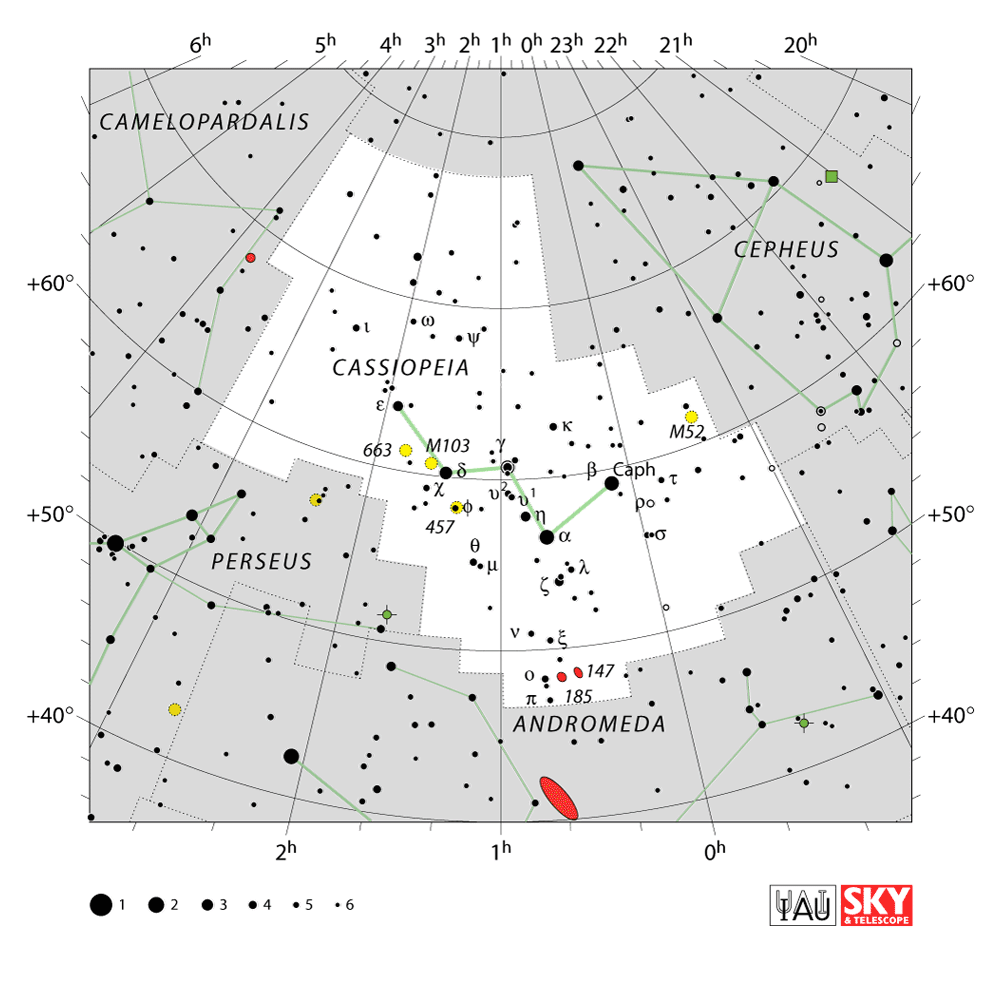
Cassiopeia is the 25th largest constellation in the night sky, occupying an area of 598 square degrees. It lies in the first quadrant of the northern hemisphere (NQ1) and can be seen at latitudes between +90° and -20°. The neighboring constellations are Andromeda, Camelopardalis, Cepheus, Lacerta, and Perseus.
Cassiopeia belongs to the Perseus family of constellations, along with Andromeda, Auriga, Cepheus, Cetus, Lacerta, Pegasus, Perseus, and Triangulum.
Cassiopeia has three stars with known planets and contains two Messier objects: M103 (NGC 581) and M52 (NGC 7654). The brightest star in the constellation is Schedar, Alpha Cassiopeiae. The Perseid meteor shower is associated with the constellation Cassiopeia.
MYTHOLOGY
In mythology, Cassiopeia was the wife of King Cepheus (represented by the neighbouring constellation Cepheus in the sky) of Ethiopia. Once, she boasted that she was more beautiful than the Nereids. The Nereids were the 50 sea nymphs fathered by the Titan Nereus. They were enraged by Cassiopeia’s comments and appealed to Poseidon to punish Cassiopeia for her boastfulness. Poseidon was married to one of the nymphs, Amphitrite.
The sea god obliged and sent Cetus, a sea monster represented by the constellation Cetus (the Whale), located in the same region of the sky, to ravage the coast of Cepheus’ kingdom. Cepheus turned to an oracle for help and the oracle told him that, in order to appease Poseidon, he and Cassiopeia had to sacrifice their daughter Andromeda to the sea monster. Reluctantly, they did so, leaving Andromeda chained to a rock for the monster to find. However, she was saved in the last minute by the Greek hero Perseus, who happened to be passing by, saw Andromeda and rescued her from the monster.
Perseus and Andromeda were later married. At the wedding, one of her former suitors, named Phineus, appeared and claimed that he was the only one who had the right to marry Andromeda.
There was a fight and Perseus, desperately outnumbered, used the head of Medusa, the monster he had recently slain, to defeat his opponents. One look at Medusa’s head turned them all into stone. In the process, however, the king and queen were also killed because they did not look away from the monster’s head in time
It was Poseidon who placed Cassiopeia and Cepheus in the sky. Cassiopeia, the myth goes, was condemned to circle the celestial pole forever, and spends half the year upside down in the sky as punishment for her vanity. She is usually depicted on her throne, still combing her hair.
Asterisms in Cassiopeia
Cassiopeia is renowned among amateur astronomers for its striking W-shaped asterism, one of the most iconic patterns in the northern sky. Five principal stars—Schedar (Alpha Cassiopeiae), Caph (Beta Cassiopeiae), Gamma Cassiopeiae, Ruchbah (Delta Cassiopeiae), and Segin (Epsilon Cassiopeiae)—trace this familiar shape, their arrangement making Cassiopeia an unmistakable landmark. In spring and summer, the W sits below Polaris, upright in the northern sky. Come winter, the entire figure pivots above Polaris, resembling an M. From southern latitudes, Cassiopeia, when visible, always appears as an M low on the horizon or inverted if viewed from more southerly vantage points. This asterism is more than an observational curiosity; it serves as a practical guide for celestial navigation, especially in tandem with the Big Dipper. The midpoint between these two asterisms marks Polaris, the North Star, and several sightlines connecting stars from Cassiopeia’s W to those in the Big Dipper reliably intersect the region of the north celestial pole. One classic method is to extend a line from Merak through Dubhe, the outer bowl stars of the Dipper, but Cassiopeia’s orientation offers useful alternatives: a line from Segin to Mizar, Schedar to Megrez, or Caph to Phecda all roughly indicate Polaris’s position.
The five principal stars of Cassiopeia’s W represent a cross-section of stellar evolution and astrophysical phenomena. Four of these stars are evolved giants or subgiants, but Segin, the leftmost star, remains a blue main-sequence star, younger and hotter than its companions. Each star offers a glimpse into a different stage of stellar life.
Schedar, an orange giant of spectral type K0IIIa, is the constellation’s brightest member, glowing at magnitude 2.24 from a distance of roughly 230 light-years. Caph, the second brightest at magnitude 2.28, is an F-type giant star located just 54.7 light-years away. Classified as a Delta Scuti variable, Caph is in a transitional evolutionary state, pulsating with a period of 2.5 hours. The star is nearly twice as massive as the Sun and has already begun its expansion toward the red giant phase. Its rapid rotation, measured at 71 kilometers per second, distorts its shape into an oblate spheroid. Caph’s name is rooted in Arabic, derived from “kaf,” meaning palm, but the star is also known by other traditional names—al-Sanam al-Nakah, al-Kaff al-Khadib—each reflecting historical attempts to map and describe the sky. Along with Alpheratz in Andromeda and Algenib in Pegasus, Caph formed part of the “Three Guides,” a trio of stars marking the equinoctial colure, the great celestial circle passing through both equinoxes.
At the center of the W sits Gamma Cassiopeiae, a blue-white subgiant approximately 550 light-years distant. This star is notable as the prototype of Be stars—rapidly rotating, hot B-type stars exhibiting emission lines from circumstellar disks. Gamma Cassiopeiae has a mass thirteen times that of the Sun and shines with 34,000 times the Sun’s luminosity, all concentrated into a radius about ten times greater than our Sun’s. Its rotational speed, an astonishing 432 kilometers per second, has shaped the star into an oblate spheroid and sustains a volatile disk of material at its equator. Variations in the disk’s structure cause the star’s brightness to fluctuate between magnitude 3.0 and 1.6. Gamma Cassiopeiae is also an exceptionally strong X-ray emitter, radiating ten times the X-ray energy of most B-type stars. The system is complex, comprising at least two spectroscopic components in a 203.5-day orbit, with further evidence suggesting a more distant tertiary companion. Surrounding Gamma Cassiopeiae are two faint nebulae, IC 59 and IC 63—collectively known as the Ghost of Cassiopeia—which are illuminated by the star’s energetic output. For cultural reference, the star has no official IAU-approved name, but is known as “Navi” among astronauts—a name bestowed by Gus Grissom, who reversed his own middle name, Ivan, for the designation.
Major Stars of Cassiopeia
Ruchbah, Delta Cassiopeiae, appears as the constellation’s fourth brightest star at magnitude 2.68, lying some 99 light-years away. This system is an eclipsing binary with a period of 759 days, during which its brightness dips modestly by 0.07 magnitudes. The primary is a blue-white subgiant, more massive and luminous than the Sun, spinning at a rate of 123 kilometers per second and exhibiting a circumstellar debris disk at about 88 astronomical units. The star’s name comes from the Arabic “rukbah,” meaning knee, and was officially assigned by the International Astronomical Union in 2016. Historically, Ruchbah was also known as Ksora, though the origin of that name remains unclear.
Segin, Epsilon Cassiopeiae, completes the W as its leftmost point. A hot blue main-sequence star of type B3 V, Segin is 470 light-years from Earth and shines at magnitude 3.37. It is nearly ten times as massive as the Sun and is only about 15 million years old—astronomically speaking, a relative infant. Segin’s spectral signature marks it as a weak periodic variable, and the origin of its name appears to be a corruption of Seginus, which rightfully belongs to a star in Boötes.
Beyond the W, Cassiopeia features several additional noteworthy stars. Achird, or Eta Cassiopeiae, is a G-type dwarf located just 19.3 light-years away, making it the closest significant star in the constellation. Achird forms a binary system with a fainter orange K dwarf, separated by an average distance of 71 astronomical units and orbiting one another over nearly five centuries. The system is classified as an RS Canum Venaticorum variable due to stellar activity that produces large starspots, resulting in minor variability.
Zeta Cassiopeiae, also known as Fulu, is a blue subgiant of spectral type B2IV. Shining at magnitude 3.66 and located 590 light-years away, Fulu pulsates slowly with a period of about five and a third days, a characteristic typical of slowly pulsating B-type stars. Its name, Fulu, derives from a Chinese asterism meaning “Auxiliary Road.”
Cassiopeia’s claim to fame extends to some of the Milky Way’s most extraordinary stellar objects. Rho Cassiopeiae is a yellow hypergiant located roughly 8,150 light-years away, easily seen at magnitude 4.5 except during rare eruptions, when it dims to sixth magnitude. Hypergiants of this type are exceedingly rare and unstable, shedding mass at prodigious rates as they evolve toward the end of their lifespans. Rho Cassiopeiae’s mass, once 40 times that of the Sun, is now matched by a radius that can reach 700 times solar, and its luminosity may top half a million Suns. Its variability is semi-regular, with outbursts occurring roughly every fifty years, and the star is likely destined for a supernova explosion within a relatively short astronomical timespan.
Similarly remarkable is V509 Cassiopeiae, another yellow hypergiant, this time some 12,400 light-years distant and shining at magnitude 4.6. Having begun life with 25 solar masses, the star now measures over 500 times the Sun’s radius and emits hundreds of thousands of solar luminosities. V509 Cassiopeiae is expected to transition into a Wolf–Rayet phase before ultimately exploding as a supernova.
Kappa Cassiopeiae rounds out this roster of massive stars as a blue supergiant, itself some 4,000 light-years away. This runaway star, thought to be a member of the OB14 association, blazes with nearly half a million times the Sun’s light and races through space with such speed that it forms a bow shock spanning twelve light-years.
Altogether, Cassiopeia stands as a microcosm of stellar astrophysics: it offers nearby solar analogs, intermediate-aged giants, young blue supergiants, and the rare, luminous hypergiants. Its familiar asterism remains a mainstay of sky navigation, while its stellar variety provides a fertile ground for both naked-eye observation and advanced study. The constellation’s brightest stars not only define its shape but also serve as reference points for finding star clusters, nebulae, and deep-sky objects scattered throughout the region—making Cassiopeia an indispensable feature of the northern sky.
Deep Space Object in Cassiopeia
Messier 52 (NGC 7654) — Open Cluster
One of the richest open clusters in Cassiopeia, Messier 52 contains over 190 stars spread across a compact region. The cluster is young (about 35 million years old) and lies roughly 5,000 light-years away. Visually, it presents as a dense sprinkling of faint stars superimposed on the rich Milky Way background.
Magnitude: ~6.9
Messier 103 (NGC 581) — Open Cluster
Another prominent open cluster, M103 is more sparse and triangular in appearance. It contains about 40 known stars, including a striking red giant, and is situated around 10,000 light-years from Earth.
Magnitude: ~7.4
NGC 457 (“Owl Cluster” or “ET Cluster”) — Open Cluster
Named for its resemblance to an owl (or “E.T.”), NGC 457 is one of the most visually striking open clusters in the sky. Two bright foreground stars form the “eyes,” with fainter stars trailing as “wings.”
Magnitude: ~6.4
NGC 7789 (“Caroline’s Rose”) — Open Cluster
Discovered by Caroline Herschel, this is a rich, older open cluster about 7,600 light-years away. Its stars form overlapping loops, resembling the petals of a rose in telescopic views.
Magnitude: ~6.7
NGC 129 — Open Cluster
A moderately rich open cluster situated about 5,200 light-years away. It appears as a loose collection of stars, with several bright members.
Magnitude: ~6.5
NGC 663 — Open Cluster
Sometimes overlooked, NGC 663 is a dense open cluster with over 80 stars. It is part of the Cassiopeia OB8 stellar association.
Magnitude: ~7.1
NGC 654 — Open Cluster
A compact open cluster with several bright stars, located near NGC 663. It’s less rich than its neighbor but still a worthwhile telescopic target.
Magnitude: ~6.5
NGC 436 — Open Cluster
A small, compact group of stars often described as “horseshoe-shaped.” Located near NGC 457.
Magnitude: ~8.8
IC 1805 (“Heart Nebula”) — Emission Nebula
A large, faint nebula about 7,500 light-years away, visible in long-exposure astrophotography or with O-III/H-beta filters. The nebula’s central region hosts the open cluster Melotte 15, surrounded by intricate gas filaments.
Magnitude: ~6.5 (integrated, but very diffuse)
IC 1848 (“Soul Nebula”) — Emission Nebula
Located just east of the Heart Nebula, the Soul Nebula is also a massive H II region, sometimes called the “Embryo Nebula.” Rich in star formation regions, it is paired with IC 1805 in widefield images.
Magnitude: ~6.5 (integrated, very diffuse)
NGC 281 (“Pacman Nebula”) — Emission/Reflection Nebula and Cluster
Named for its resemblance to the arcade character, NGC 281 is a bright star-forming region about 9,500 light-years away. It contains Bok globules and a small open cluster (IC 1590) at its center.
Magnitude: ~7.4
Caldwell 18 (NGC 185) — Dwarf Spheroidal Galaxy
A faint, elliptical satellite galaxy of Andromeda (M31), NGC 185 is one of only two galaxies in Cassiopeia that can be observed visually in amateur telescopes under dark skies.
Magnitude: ~9.2
Caldwell 17 (NGC 147) — Dwarf Spheroidal Galaxy
Similar to NGC 185, NGC 147 is another satellite of Andromeda, faint and elliptical, and lies close by in Cassiopeia’s sky.
Magnitude: ~9.5