
venus
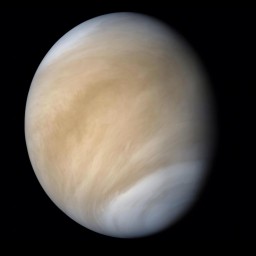
Venus: Earth’s Fiery Twin
Venus is often called Earth’s “sister” planet – similar in size and composition, yet drastically different today. With a radius of about 6,051.8 km (≈0.949 Earth) and mass ≈4.867×10^24 kg (≈0.815 Earth), Venus’s mean density (5.24 g/cm³) is also Earth-like. Internally it is differentiated into core, mantle and crust; seismic studies and modeling suggest a metallic iron core (possibly partially liquid) surrounded by a high-pressure silicate mantle. Unlike Earth, Venus shows no evidence of plate tectonics; its crust appears to be a single stagnant shell, but it may still exhibit volcanism and resurfacing events
Near-surface conditions on Venus are extreme. Surface temperatures run around 735 K (462°C) – hot enough to melt lead – due to a runaway greenhouse effect in its dense CO₂ atmosphere. Surface pressure is about 92–93 bar (≈92 atm). The atmosphere is ~96.5% CO₂ and 3.5% N₂, with traces of SO₂, H₂O, CO, and inert gases. Thick clouds of concentrated sulfuric acid droplets enshroud the planet (making it perpetually shrouded in white and yellow clouds). These clouds trap heat efficiently, yielding the intense greenhouse warming. Surface winds are very weak (a few km/h) due to the high density, but at cloud-top altitudes the atmosphere super-rotates: winds exceed 100 m/s (≈360 km/h) – about 60× faster than the planet’s 243-day rotation. Vigorous Hadley-like circulation and polar vortices are driven by this super-rotation. Overall, Venus’s atmosphere is ~90× denser and much hotter than Earth’s, making its surface environment hellish by terrestrial standards
Atmospheric Composition and Dynamics
Venus’s atmosphere is dominated by carbon dioxide, with thick sulfuric acid cloud decks. By volume it is ≈96.5% CO₂ and 3.5% N₂. Trace gases (SO₂, H₂O, CO, HCl, HF, O₂, Ar, Ne, etc.) occur at ppm levels. The surface pressure (~9.3 MPa) and temperature (~735 K) exceed Earth’s by two orders of magnitude. This dense CO₂-rich air creates an extreme greenhouse effect: sunlight warms the surface, and infrared radiation is trapped by the thick CO₂, keeping Venus’s surface hotter than Mercury’s despite being farther from the Sun.
Persistent sulfuric acid clouds span altitudes ~50–70 km, blocking optical view of the surface. These clouds form via photochemical reactions involving SO₂ and H₂O. They also contain mysterious dark regions visible in ultraviolet light. Orbiter UV images show a complex “Y-shaped” band of unknown UV-absorbing material circling the planet. The nature of these absorbers (proposed candidates include iron chloride or even biological pigments) remains unsolved. Electric activity (lightning) has also been inferred, though evidence is mixed.
Despite the inferno below, Venus’s upper atmosphere has surprisingly Earth-like layers. At ~50–60 km altitude, pressures and temperatures are similar to those on Earth’s surface (around 1 atm and ~300 K). This has led to speculation that microbes could survive in the temperate cloud decks. (For example, the disputed detection of phosphine gas in 2020 hinted at potential biology, but later reanalysis strongly questioned that claim.) The upper atmosphere thus attracts astrobiological interest as the most “habitable” region of Venus’s current environment.
Gas motions show global super-rotation: the entire atmosphere circles the planet much faster than the solid body rotates. At ~70 km altitude, the zonal (east-west) winds exceed 360 km/h, completing a circle in about 4 Earth days, while the surface rotation period is 243 days. Near the poles lie huge double-eyed polar vortices – giant hurricane-like storm centers detectable in ultraviolet cloud patterns. In contrast, winds at the surface are very slow (on the order of 10 km/h). How Venus maintains this super-rotation against friction is an active research topic.
Orbit and Rotation
Venus orbits the Sun every 224.7 Earth days at an average distance of 0.723 AU. Uniquely, it rotates retrograde (opposite to most planets): it spins once every 243.0 Earth days in the opposite direction of Earth’s rotation. In other words, the Sun would rise in the west and set in the east on Venus. Because of this retrograde spin and orbital motion, the solar day (sunrise-to-sunrise) on Venus is about 116.8 Earth days long Thus, a Venusian day (116.8 d) is half its year (224.7 d).
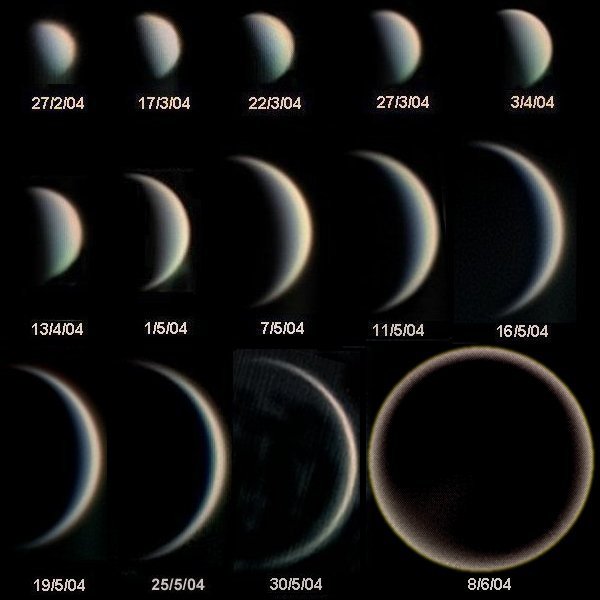
Venus’s axial tilt is only about 3°, so it has virtually no seasons. Its orbit is nearly circular (eccentricity ≈0.0068), so solar distance varies little. From Earth, Venus’s apparent position always lies close to the Sun. The maximum elongation (greatest separation from the Sun in our sky) is ~47°. This means Venus is visible only as a “morning star” or “evening star” – near dawn or dusk – never high in the midnight sky. Because of the changing Sun-Venus-Earth geometry, Venus goes through a full cycle of phases (full, gibbous, quarter, crescent) like the Moon, but in reverse: it is brightest when a large crescent is illuminated, and appears nearly full (but tiny) at greatest distance. The interplay of its phases, size, and brightness is illustrated in sky charts and photographs.
Historical Observations
Venus has been known since antiquity as the brilliant “morning star” and “evening star.” Ancient civilizations (Babylonian, Greek, Indian, Chinese, etc.) noted its shifting appearance and eventually recognized it as a single planet with two apparitions. In classical times, it was often called Phosphorus (dawn) and Hesperus (dusk). The planet’s phases became the crucial test of heliocentrism: in 1610 Galileo Galilei used a telescope to see that Venus exhibited a full set of phases, just like the Moon. This observation was incompatible with the Ptolemaic geocentric model and provided strong support for Copernicus’s Sun-centered system.
Later telescopic studies measured Venus’s slow rotation and hinted at an atmosphere. In 1761, Mikhail Lomonosov observed a thin arc of light around Venus during a transit and correctly inferred the presence of a dense atmosphere. (Christiaan Huygens had earlier hypothesized a Venusian atmosphere in 1698 based on its disk’s uniform brightness.) Throughout the 18th–19th centuries, observers charted surface brightness variations and the phases of Venus, but the clouds thwarted direct viewing of the surface. By the 20th century, spacecraft carried the study forward: for example, Mariner 2’s 1962 flyby was the first robotic visit to another planet.
Transits of Venus across the Sun – rare events in pairs separated by over a century – were especially important historically. Timings of the 1761 and 1769 transits (and later 1874/1882) helped measure the astronomical unit. More recently, the transits of 2004 and 2012 were closely observed worldwide. (The next transits won’t occur until 2117 and 2125.) Such events are so infrequent that each is a major public occasion and scientific opportunity.
Observing Venus from Earth
Venus is the third-brightest object in Earth’s sky (after the Sun and Moon) and is easily visible even to the naked eye. Its apparent magnitude varies between about –4.9 and –2.4. Near inferior conjunction (when it lies between Earth and Sun), Venus can peak near –4.7 to –4.9, outshining all stars and planets. During greatest elongation, Venus may shine around –4 to –4.5. By comparison, the full Moon is –12.7 (but covers far more sky). Venus actually has a higher surface albedo (~0.7) than the Moon (~0.12), making it very bright per square arc-second. (This is why it can even be spotted in daylight if you know where to look.)
Venus phase sequences
Phases and viewing: Through a small telescope or strong binoculars, one can see Venus’s changing phase. When Venus is on the far side of its orbit it appears nearly full but tiny, and as it approaches Earth its phase shrinks to a razor-thin crescent while its apparent diameter grows. The planet’s phase is opposite the Moon’s: Venus is brightest when a large portion is dark (thin crescent). For example, the breathtaking crescent seen in the evening sky just after inferior conjunction occurs when Venus is closest and largest – also when its brightness peaks at about –4.7. (Observers note that Venus’s dazzling glare makes safe observation advice important: always ensure the Sun is well below the horizon before pointing any optics at Venus to avoid eye damage.)
Since the planet has an atmosphere, it can be seen at new in a telescope by the halo of light refracted around the planet. The full cycle from new to full to new again takes 584 days (the time it takes Venus to overtake the Earth in its orbit). Venus (like the Moon) has 4 primary phases of 146 days.
Elongation and timing: Venus’s greatest east and west elongations (~47°) mark the times when it is most widely separated from the Sun in our sky, making it easiest to see after sunset or before sunrise. After greatest eastern elongation, Venus appears in the west after sunset (evening star); after greatest western elongation it rises before dawn (morning star). Its visibility window can last a few hours. At smaller elongations or near superior/inferior conjunction, Venus is lost in the Sun’s glare and nearly invisible. Because its orbit is inclined a few degrees to the ecliptic, Venus never ventures far above the Sun’s path.
Brightness and color: Venus glows a brilliant white-yellow to the eye. Through binoculars, the globe looks featureless – the bright clouds dominate. No surface features are visible (its surface is hidden), but subtle cloud banding can sometimes be seen. Using ultraviolet or narrowband filters, amateur astronomers can tease out dark and light patterns on the clouds. Venus’s brightness can vary with phase: when it presents only a thin crescent, more sunlight is reflected directly toward Earth, making it most luminous.
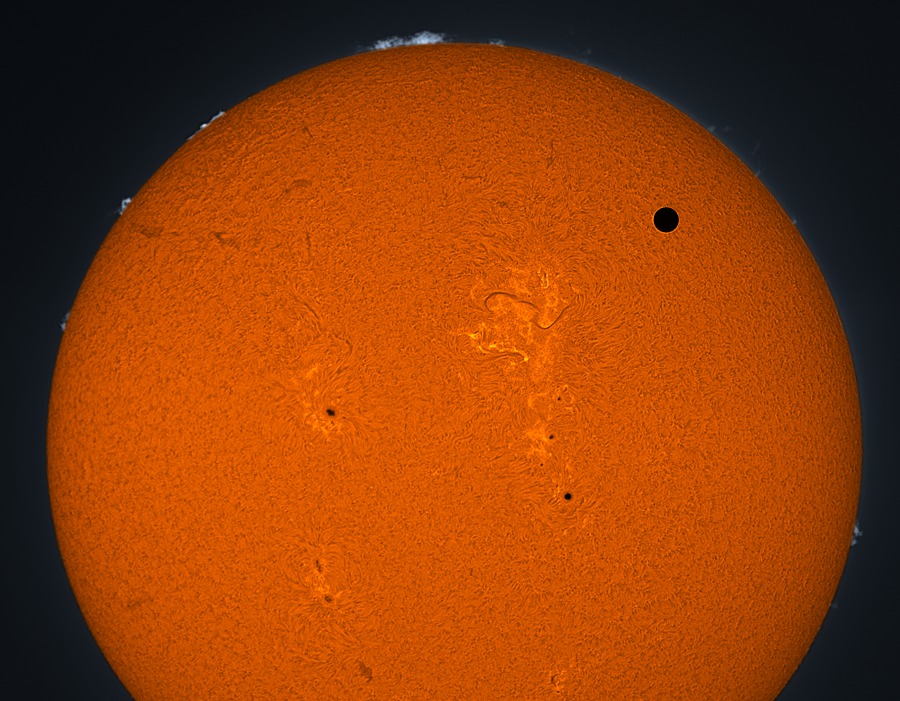
Venus (black dot) seen crossing
the solar disk
Transits of Venus: Rarely, Venus crosses the Sun’s disk. These transits are solemnly predictable yet infrequent (pair separations of 8 years then gaps of ~105 or 121 years). During the 2012 transit, for instance, observers across the Pacific and Asia tracked Venus’s 6½-hour path across the Sun. Such an event is safe to photograph only with proper solar filters. Historically, transits were used to measure the Earth–Sun distance. In modern times they provide a “venusian silhouette” comparable to exoplanet transits.
Mysteries and Research Frontiers
Despite its exploration, Venus still holds many scientific puzzles:
Volcanic activity
Venus has thousands of volcanoes and vast lava plains, but whether any are currently active remains uncertain. Thermal imaging and near-infrared emissivity maps suggest recent lava flows and hot spots. Venus Express detected localized infrared hotspots and transient clouds consistent with active volcanism. The new radar of VERITAS and EnVision will look for fresh flows and eruption plumes, to test if Venus is still volcanically alive.
Atmospheric super-rotation
The physics driving the extreme wind speeds (super-rotation) is not fully understood. Models include tidal forces, thermal tides, and momentum transport by waves. JAXA/Akatsuki’s data on atmospheric waves and NASA climate models are probing this.
Unexplained UV absorbers
The dark UV patterns in the cloud tops are still unidentified. Proposed candidates include FeCl₃ (iron chloride) or sulfur compounds. This “UV absorber” mystery might be solved by spectroscopy from orbit or balloon platforms.
Aerosol chemistry and photochemistry
The sulfur cycle (formation of H₂SO₄ clouds from SO₂ and water) and possible unknown chemicals (e.g. phosphine debate) continue to intrigue chemists. Small amounts of microbes were once hypothesized to exist in the clouds; the phosphine story (initial reports of PH₃, later retractions) highlights how astrobiology pushes new observations and caution.
Magnetic environment
Venus has no intrinsic magnetic field, yet its ionosphere interacts with the solar wind to create an induced magnetosphere. Unexpected features like “bow shocks” and ion tails (a comet-like tail of atmospheric ions) have been found. How Venus’s atmosphere is slowly stripped by the solar wind remains an active study, relevant to atmospheric evolution.
Interior and tectonics
Gravity data suggest a partially molten interior, but whether Venus has plate tectonics or an Earth-like heat engine is unresolved. The pattern of tesserae highlands and coronae hints at mantle plumes and lithospheric instabilities. EnVision’s gravity mapping will probe Venus’s internal layering.
Ancient habitability
Geological and isotopic evidence (e.g. D/H ratio 100× Earth’s) implies Venus may once have had abundant water. The timeline and extent of any habitable epoch (possibly billions of years ago) is unknown. Understanding Venus’s climate runaway could inform models of Earth’s future and of exoplanet habitability.
Each new mission and observation peels back layers of Venus’s mysteries. Despite its hellish present, Venus remains a key reference for comparative planetology. Its enigmatic climate and history continue to challenge scientists, ensuring that Venus will be a focus of planetary research for years to come.