
The Sun’s chromosphere
What Is the Chromosphere?
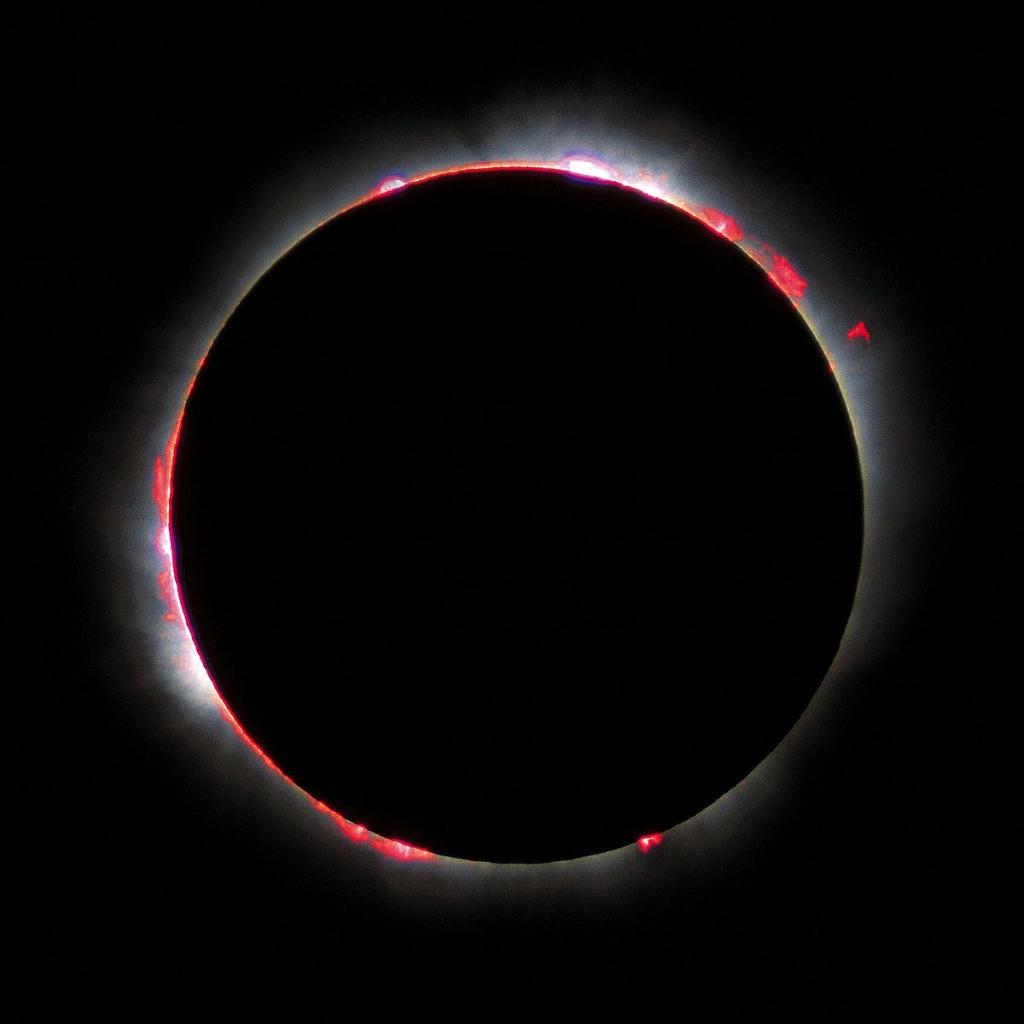
The chromosphere (meaning “color-sphere”) is a thin, irregular layer of the Sun’s atmosphere located between the bright photosphere and the outer corona. It is only a few thousand kilometers thick – extremely shallow compared to the Sun’s ~700,000 km radius. Within this layer, the temperature rises from roughly 6,000 °C at the base to about 20,000 °C at the top. At these higher temperatures, hydrogen gas emits light predominantly in the deep-red H-alpha wavelength, giving the chromosphere its characteristic ruby glow. This reddish glow is normally invisible from Earth’s surface because the chromosphere is very tenuous and transparent, so its light is drowned out by the far brighter photosphere beneath. Only when the photosphere is obscured – for example, during a total solar eclipse – does the chromosphere reveal itself as a thin red fringe around the Sun. (It was this colorful flash that earned it the name “chromosphere.”) Above the chromosphere lies the Sun’s corona, a super-hot but ultra-low-density halo that is usually visible only with special instruments or during eclipses. In essence, the chromosphere forms a transition between the Sun’s visible surface and its hot outer atmosphere, differing from the photosphere by its reddish emission and higher temperature, yet still far cooler and denser than the sprawling million-degree corona above.
Observing the Chromosphere
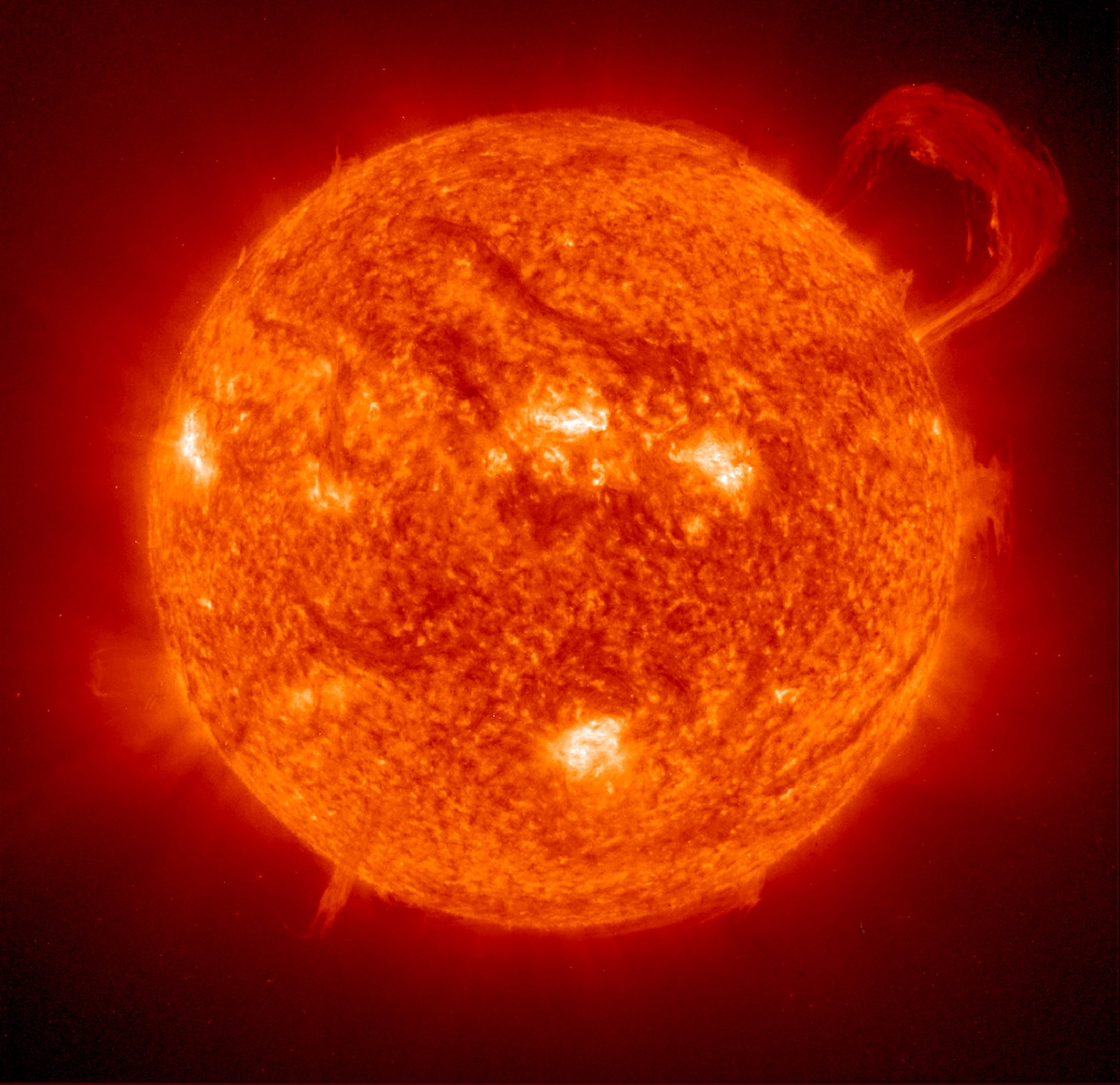
Because the chromosphere’s light is faint compared to the photosphere, special methods are needed to observe it. One way is during a total solar eclipse, when the Moon blocks the photosphere and unveils the chromosphere for a brief few minutes. You may then see a red rim around the Sun, with pinkish flames or prominences jetting outward – a truly awe-inspiring sight. However, you don’t have to wait for an eclipse to explore the chromosphere. With a properly equipped telescope using a narrowband hydrogen-alpha (Hα) filter, you can observe the chromosphere any clear day in real time (always using appropriate solar filters and precautions). H-alpha filters isolate the 656.3 nm red line of hydrogen, essentially creating an artificial eclipse by blocking the photosphere’s glare and letting only chromospheric light through. When you look through an H-alpha solar telescope, the Sun is transformed from a steady white-yellow disk into a seething orange-red ball of activity. Suddenly, you can peer into the chromosphere, the layer directly above the photosphere, and witness a wealth of detail. The solar disk in H-alpha appears mottled and alive – you’ll see dark filaments snaking across it, bright patches marking active regions, and prominences leaping from the edge. Features that are invisible in normal “white light” viewing become obvious. In effect, H-alpha equipment pulls back the curtain and exposes the Sun as a dynamic, ever-changing star. Amateur astronomers often describe their first H-alpha view as revelatory – you realize the Sun has weather! You can actually watch many chromospheric phenomena evolve over minutes or hours, making solar observing a thrilling pursuit for those with the right tools.
Features of the Chromosphere
When you observe the Sun in H-alpha or examine high-resolution images, several distinct chromospheric features come into view. These features are driven by the Sun’s magnetic fields and plasma motions, and they offer a tangible glimpse of the Sun’s complexity. Here are some of the key phenomena you can see or image with amateur-level equipment:
Spicules:
These are small, jet-like eruptions that carpet the entire chromosphere. Spicules appear as tiny short-lived spikes along the solar limb (they give the Sun’s edge a fine, fuzzy “fur” appearance in H-alpha views). Each spicule is a narrow column of plasma about a few hundred kilometers wide that shoots upward from the lower chromosphere. They are typically a few thousand kilometers tall and last only a few minutes before fading and being replaced by new ones. In H-alpha images, spicules show up as countless short dark streaks when seen against the disk. They trace the boundaries of cell-like areas in a pattern called the chromospheric network. Despite their brief lives, spicules play a role in churning material upward – ejecting plasma at about 20–30 km/s (roughly 45,000–67,000 mph) into the upper atmosphere, where some of that material contributes to heating the low corona. For you as an observer, spicules are most noticeable at the solar limb: try increasing magnification on the edge of the Sun and you’ll see the rim isn’t smooth but bristled with fine spikes that seem to wave and change over minutes.
Prominences and Filaments
Prominences are among the most eye-catching chromospheric features. They are large, cloud-like structures of relatively cool, dense plasma suspended above the Sun’s surface by magnetic field loops. When seen projecting from the Sun’s edge against the dark sky, they appear as towering, luminous loops or plumes—sometimes resembling tree-like arches, spikes, or curtains of glowing gas. These are the same prominences you might glimpse during an eclipse, and even a modest H-alpha telescope will reveal them hovering beyond the solar limb on any given day. Prominences can reach enormous sizes (many times the size of Earth) and often have intricate, wispy details. They are broadly classified into quiescent prominences, which hang in place and evolve slowly, and active prominences, which are associated with flares and eruptive events and can change shape rapidly. Viewed against the Sun’s face, the very same structures appear dark instead of bright – we then call them filaments. Filaments look like long, sinuous threads or ribbons draped across the solar disk. They appear dark because they are slightly cooler and denser than the hot background chromosphere, thus absorbing light. Importantly, filaments and prominences are actually the same physical phenomena – the distinction is purely one of perspective. If a prominence at the limb travels around with the Sun’s rotation onto the disk, it will show up as a dark filament, and vice versa. Both filaments and prominences can persist for days or weeks, stably hanging in the chromosphere. Yet they are not static: if the supporting magnetic fields shift or destabilize, these suspended clouds can erupt. In an eruption, a filament may suddenly lift off and rocket into space over the course of minutes or hours. As an H-alpha observer, you can watch prominences in real time – quiescent prominences might slowly sway or develop twists, while active ones surge and change visibly over even a few minutes. Filaments on the disk may also slowly snake around or even lift off and disappear. Catching a filament eruption or a dramatic looping prominence through your telescope is an unforgettable experience, vividly illustrating the Sun’s power.
Plages and Active Regions
Plage (French for “beach”) refers to bright chromospheric patches usually found around sunspots or where sunspots are about to form. In H-alpha, plages show up as pale, cloud-like brightenings in the areas of strong magnetic field within active regions. They often appear as irregular, bright blobs or networks of bright filaments near sunspot groups. Plages are basically the chromospheric counterparts of photospheric faculae (bright magnetic regions visible in white light near the limb) – they highlight where intense magnetic flux is concentrated above the Sun’s surface. In a live view, you’ll notice that an active region on the Sun is surrounded by a bright chromospheric network of plage. In fact, even if a sunspot is not yet visible in white light, you might detect a bright patch of plage in H-alpha indicating a developing active region. Plages, along with smaller bright points called filigree, outline the boundaries of huge convection cells called supergranules, forming a web-like pattern across the Sun. This network becomes particularly visible in deep H-alpha or in calcium K-line images of the chromosphere. For the amateur observer, plages are often the first thing you notice when you tune your filter: they make the Sun’s disk look textured and “active,” even in areas away from sunspots. As solar activity ramps up, plage regions become more numerous and prominent. Monitoring plages over days can also be rewarding – you might see new plages emerge or existing ones fade as sunspot groups evolve.
In addition to the above features, the chromosphere is the stage for dynamic events like solar flares. A solar flare is an explosive release of energy in an active region, often seen in H-alpha as a sudden intense brightening in or around a sunspot group. Flares originate in the chromosphere and low corona, powered by magnetic reconnection. With an H-alpha telescope, you can catch flares as they happen – they appear as brilliant, irregular patches or ribbons that can brighten and fade within minutes to hours. You might see a flare’s location light up and even form expanding arcs or loops as hot plasma races along magnetic field lines (these post-flare loops glow in H-alpha as well). It’s truly astonishing to watch a flare in real time, knowing that you’re witnessing a titanic explosion on the Sun’s surface from your backyard. Additionally, filaments and prominences can erupt dramatically, as mentioned, sometimes flinging material into space as part of a coronal mass ejection. All of these phenomena – spicules, prominences, filaments, plages, flares – are observable aspects of the chromosphere’s activity, and they underscore that the Sun is anything but a static ball of light. Even with amateur equipment, you can actively study the ebb and flow of our star’s magnetism by watching these features evolve.
Transition to the Corona
As you move upward through the Sun’s atmosphere, the chromosphere gradually fades and gives way to the transition region and corona. The transition region is a very thin, haphazard layer above the chromosphere where the temperature of the solar plasma skyrockets over a short distance. In the span of just a few hundred kilometers, the gas goes from ~20,000 °C at the top of the chromosphere to nearly 1,000,000 °C (and beyond) in the low corona. This abrupt heating marks the start of the corona, the Sun’s outer atmosphere. The transition region itself is hard to observe directly — at those extreme temperatures, hydrogen is completely ionized (stripped of its electrons) and no longer emits the visible H-alpha glow. Instead, this region shines primarily in ultraviolet light emitted by highly ionized atoms (like C IV and O IV), which can only be observed with space telescopes. For amateur astronomers, the transition region is more of a conceptual boundary than a visible layer. You won’t see it in your telescope, but you do see its consequences: it’s where the chromospheric structures you’ve been observing (like prominences) extend upward and become part of the corona. In fact, many prominences bridge the chromosphere and corona – their bases are rooted in the chromosphere, but their tops float in the lower corona. During a total eclipse, after the last flash of the chromosphere’s red light, the corona appears as a pearly white halo with faint streamers – you’re then looking at solar plasma that has traversed the transition region and is heated to millions of degrees. The chromosphere and transition region together form the gateway between the Sun’s visible surface and its outer space environment. The existence of the transition region also reminds us of the intriguing difference between the chromosphere and corona: the corona is far hotter than lower layers, a longstanding solar physics puzzle. Energy from the Sun’s interior somehow heats the sparse corona to temperatures hundreds of times hotter than the chromospheric plasma below. The chromosphere plays a role in this process, perhaps via waves or magnetic reconnection events that propagate upward, but the exact mechanisms are an active area of research.