
The Tachocline
The Sun’s Tachocline
What Is the Tachocline
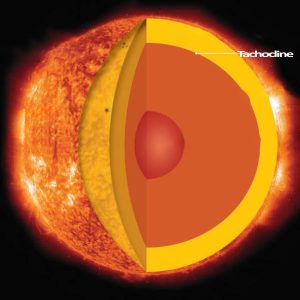
When you explore the Sun’s interior, you encounter a thin but significant boundary layer called the tachocline. This is the transition region between the Sun’s deep radiative zone (where the solar plasma rotates almost like a solid ball) and the overlying convective zone (where the plasma rotates differentially, with the equator spinning faster than the poles). In other words, as you move outward from the Sun’s center, the tachocline is the place where the Sun’s rotation pattern suddenly changes – from uniform rotation in the core to a latitude-dependent, differential rotation in the outer layers. Because the rotation rate shifts so sharply in this layer, the tachocline is a zone of very strong shear (think of it as adjacent layers of gas sliding past each other at different speeds).
To give you a mental picture, imagine the Sun cut in half: the inner regions (up to about 70% of the Sun’s radius) rotate together almost as one, while the outer 30% churns and spins faster at the equator than at the poles. The tachocline is the thin boundary that separates these regimes. In fact, helioseismic measurements (more on those shortly) place the tachocline at roughly 0.70 times the Sun’s radius from the center – that’s about 500,000 km out from the core, or around 200,000 km beneath the visible surface. It’s not a thick layer at all; the tachocline’s thickness is estimated to be only on the order of 0.04 times the Sun’s radius (on the order of 20–30 thousand kilometers). For context, that’s less than 5% of the Sun’s radius – extremely thin by solar standards, which is one reason the tachocline fascinates solar physicists.
This transitional layer likely isn’t perfectly uniform all the way around the Sun. There is evidence that the tachocline’s exact depth might vary with latitude (one study suggests it sits a bit “higher” or “lower” in the Sun depending on whether you’re near the equator or closer to the poles). In shape it may be slightly prolate, meaning the boundary is not a perfect sphere inside the Sun but possibly a bit distorted – deeper under the poles and shallower under the equator, or vice versa, by a few percent. Regardless, in all latitudes it remains an exceptionally thin, shear-filled region.
You might be curious about the name “tachocline.” It was coined in 1992 by astronomers Edward Spiegel and Jean-Paul Zahn, by analogy to the Earth’s oceanic thermocline (a thin layer in the ocean where temperature changes rapidly with depth). Here, “tacho” is from the Greek tachy, meaning speed – a nod to the changing rotation speeds across this layer – and “cline” means a gradient or layer. So tachocline literally suggests a layer defined
How Was the Tachocline Discovered and Observed
Unlike sunspots or solar flares, you cannot see the tachocline directly by looking at the Sun’s surface. It lies deep in the solar interior, about 500,000 km down, so our knowledge of it comes from clever indirect methods rather than direct imaging. The primary tool for uncovering the tachocline was helioseismology – the study of the Sun’s interior by observing oscillations (sound waves) on the Sun’s surface. Essentially, the Sun rings like a bell with millions of different sound wave modes traveling through it, and by analyzing those vibrations, scientists can infer the internal structure and rotation of the Sun (similar to how geologists use earthquakes to probe Earth’s interior).
In the late 20th century, helioseismology delivered one of its most startling revelations: it mapped out the Sun’s internal rotation profile. Data from networks of ground-based telescopes and space missions allowed researchers to “invert” the oscillation data and see how fast different depths and latitudes inside the Sun are rotating. By 1989, researchers had strong evidence that the Sun’s surface differential rotation persists throughout the convection zone, but that below a certain depth the rotation becomes uniform. Then, in the mid-1990s, the advent of space observatories like SOHO (the Solar and Heliospheric Observatory) provided continuous, high-quality helioseismic data that definitively revealed the tachocline. Instruments on SOHO – notably the Michelson Doppler Imager (MDI) – measured the subtle Doppler shifts of the Sun’s oscillating surface. From those measurements, scientists could infer that around the base of the convection zone (~0.70 R☉), the differential rotation pattern “rapidly disappears,” giving way to a constant rotation rate in the radiative interior. In other words, SOHO’s helioseismic maps showed that the equator-to-pole speed difference which is obvious at the surface fades out abruptly at that depth – this marked the tachocline.
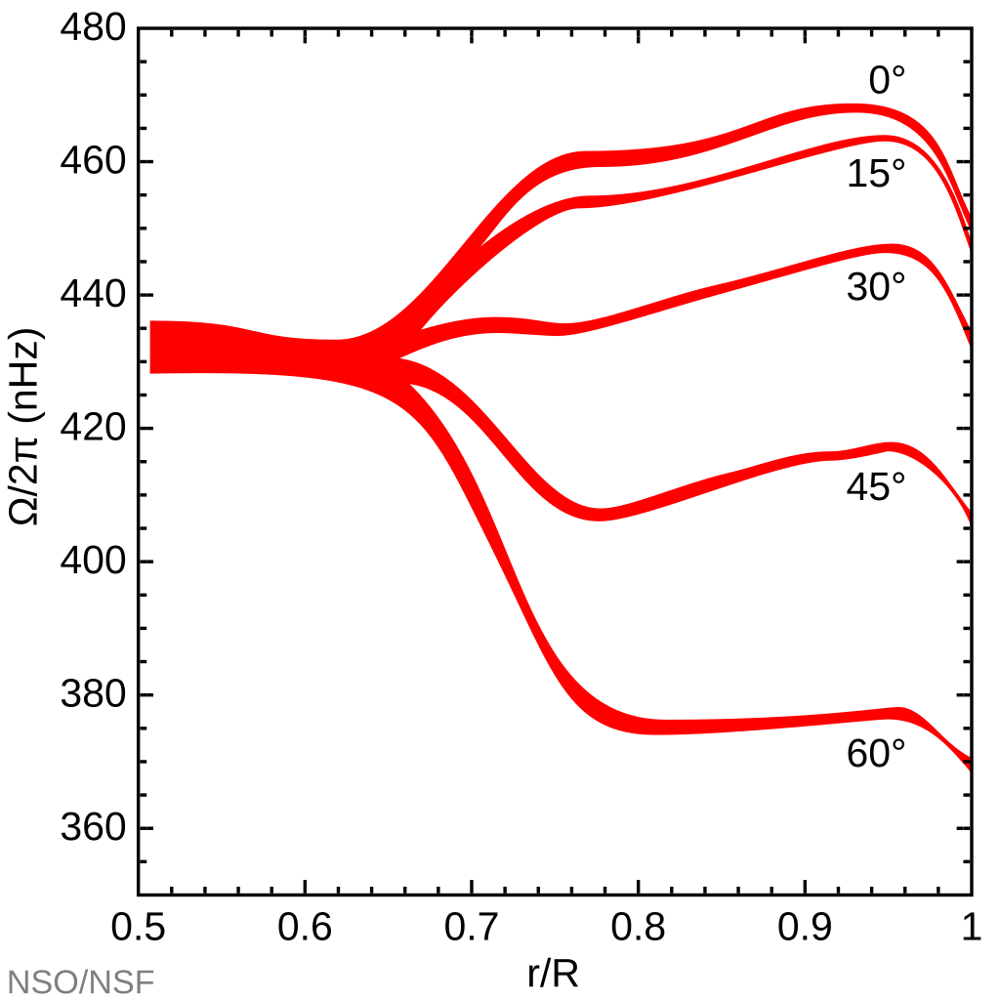
Figure 1: Internal rotation rates inside the Sun at various latitudes (0° = equator, 15°, 30°, 45°, 60° = increasingly higher latitudes). The horizontal axis is fractional radius (r/R☉), and the vertical axis is angular rotation frequency (in nanoHertz, nHz). Notice how the rotation profiles for different latitudes separate in the outer layers (differential rotation) but converge toward a common value deeper down. The convergence happens around r ≈ 0.7 R☉, indicating the tachocline – the transition to uniform rotation below. (Data courtesy of helioseismic observations from GONG/MDI.)
Following SOHO, the Solar Dynamics Observatory (SDO), launched in 2010, continued this work with even greater precision. SDO’s Helioseismic and Magnetic Imager (HMI) has been monitoring the Sun’s oscillations and magnetic fields continuously for years, allowing scientists to track the tachocline through an entire solar cycle and beyond. The combined datasets from SOHO, SDO, and other helioseismology programs (such as the global GONG network) have given us a consistent picture: the tachocline sits at roughly the same depth (~0.70 R☉) and remains remarkably stable in position and thickness over time. In fact, recent analyses of over two decades of data (covering Solar Cycles 23 and 24) found that the tachocline’s radius and thickness do not change significantly with the 11-year solar cycle. This was an important refinement to our understanding – it suggests the tachocline is a permanent structural feature of the Sun, not something that inflates or contracts as the Sun’s magnetic activity rises and falls. However, these studies did notice that the strength of the shear within the tachocline does vary with the solar cycle. In other words, while the location of the tachocline is fixed, the flow speeds in that layer can fluctuate: the shear becomes a bit stronger or weaker in concert with the Sun’s magnetic cycle. Interestingly, the pattern of those variations differed between the last two cycles, hinting at complex interactions between the Sun’s internal rotation and its magnetic activity. This is a current research topic – scientists are investigating whether those subtle tachocline flow changes could be linked to differences in solar cycle behavior.
It’s worth emphasizing that our observation of the tachocline is indirect. We “see” it through the effect it has on oscillation frequencies and rotation inversions. No probe or telescope can directly image the Sun’s interior. Missions like SOHO and SDO essentially gave us a sonogram of the Sun, from which the tachocline emerges as a distinct feature. As of today, helioseismology remains the most powerful technique to study this hidden layer. Future missions and instruments may improve the resolution or offer different vantage points (for example, by observing the Sun’s far side or poles better), but the basic approach will be the same: using waves or fields as tracers of what’s happening in the deep interior.
Key Characteristics of the Tachocline
From helioseismic observations and modeling, astronomers have deduced several key properties of the Sun’s tachocline:
Depth:
Centered at about 0.70 R☉ (70% of the Sun’s radius from the core). In other words, the tachocline is roughly 490,000–500,000 km from the Sun’s center, which is about 200,000 km below the visible surface. This is essentially the base of the convection zone. The radiative zone lies below, from the Sun’s core (~0.25 R☉) up to this 0.70 R☉ interface.
Thickness:
Approximately 0.04 R☉ (only ~4% of the Sun’s radius) or even less. In absolute terms this is on the order of 20–30 thousand kilometers thick. It’s a very thin “shear layer.” In fact, some researchers note that 0.04 R☉ might be just an upper bound limited by resolution – the true tachocline could be even thinner! This extreme thinness remains a point of fascination and investigation (as we’ll discuss later).
Rotation Profile:
Above the tachocline (in the convective zone), the Sun rotates differentially – for example, a solar “day” at the equator is about ~25 Earth days, while near the poles it’s around ~34 days. Below the tachocline (in the radiative interior), the Sun rotates as a solid body – roughly one rotation every ~27 days, the same rate as the mid-latitudes of the surface. The tachocline is where this transition happens: moving through it, the rotation rate “flattens out” from the variable surface rate to a single constant rate in the deep interior.
Shear and Flow:
The tachocline by definition has a strong radial shear – the layer above is moving (rotating) significantly faster or slower than the layer immediately below. This shear is the strongest large-scale velocity gradient in the Sun aside from the surface itself. There is also a latitudinal shear component (because just above the tachocline, different latitudes move at different speeds, whereas below it, latitudes all rotate together). Helioseismic data indicate the radial shear is strongest around mid-latitudes and even changes sign at around 35° latitude (meaning the detailed behavior of the shear differs between low and high latitudes). The magnitude of these shear flows can subtly increase or decrease over the solar cycle, though the layer’s average position stays fixed.
Shape and Latitude Variation:
The tachocline is often assumed to be spherical for simplicity, but evidence suggests it might be slightly irregular. Studies have found that the tachocline’s central radius is a bit different when measured at the equator versus near the poles. One analysis (Charbonneau et al. 1999; Basu & Antia 2003) inferred that the tachocline might sit at roughly ~0.713 R☉ at the equator but closer to ~0.68 R☉ at high latitudes (these numbers are approximate from models) – meaning the layer is slightly “deeper” under the poles than under the equatorial region. This prolate shape could be due to forces like rotation, magnetism, or how convection feeds down into the layer. The exact latitudinal variation is still being refined, but the difference is on the order of a few percent in radius.
Chemical Composition Gradient:
Interestingly, the tachocline also seems to mark a boundary in the Sun’s chemical makeup. There is evidence of sudden changes in the abundance of certain elements across this layer. In particular, helium and heavier elements that gradually settle under gravity in the radiative zone (over billions of years) are well-mixed above in the convection zone, so there may be a jump in composition at the tachocline interface. In plain terms, the tachocline acts like a barrier to mixing, so above it the Sun’s plasma is well-stirred by convection, but below it the gas is more pristine and stratified. This composition difference is subtle but has been detected in helioseismic signals and is an active area of study. It provides clues that the tachocline is also a transition in the Sun’s material properties, not just rotation.
Why is the Tachocline Important?
The tachocline might sound like an esoteric detail deep inside the Sun, but it holds the key to several of the Sun’s most crucial phenomena. Most notably, the tachocline is believed to be the cradle of the Sun’s magnetic field – the heart of the solar dynamo mechanism that drives the 11-year sunspot cycle and related magnetic activity.
You probably know that the Sun has a strong magnetic field, which flips polarity every 11 years and powers things like sunspots, flares, and coronal mass ejections. How does the Sun generate and sustain such a magnetic field? The leading theory is the dynamo theory, which involves the interplay of electrically conducting plasma flows inside the Sun. In simple terms, a dynamo converts kinetic energy (motion of plasma) into magnetic energy. The tachocline comes into play as follows: it is a region of enormous shear, and such shear flows are extremely good at amplifying magnetic fields. As the Sun rotates differentially, any small magnetic field lines that thread through the tachocline get stretched and wound up by the shear. This process can turn a weak north-south (poloidal) magnetic field into a much stronger east-west toroidal magnetic field. In dynamo terminology, this is called the “Ω-effect” (omega effect), and the tachocline is the prime site for it. The layer’s very name – tachocline, implying a velocity gradient – points to this role: the change in flow velocity across the layer “stretches” magnetic field lines and makes them stronger.
Solar physicists often describe the tachocline as the engine or seat of the solar dynamo. In many solar models (specifically, interface dynamo models), the Sun’s global magnetic field is generated in a two-step process: the tachocline’s shear first creates strong toroidal magnetic fields (Ω-effect), and then the turbulence in the convection zone twists some of that toroidal field back into poloidal field (the “α-effect”), completing the cycle. The tachocline’s role is central because it can store strong magnetic fields and then, when those fields become buoyant, they rise to the surface to create sunspots. This idea neatly explains why the Sun’s spots emerge at certain latitudes and follow an 11-year cycle – it all ties back to processes happening down in the tachocline.
It’s now widely thought that the Sun’s global magnetic field is generated by a magnetic dynamo action in the tachocline region. NASA scientists describe this interface layer as the place “where the Sun’s magnetic field is thought to be generated”. The shear flows in the tachocline effectively act as a magnetic field amplifier. Without the tachocline (or something like it), the Sun might not be as magnetically active; the interface between the spinning core and the differently spinning envelope provides the “machine” that winds up magnetic fields to solar proportions. It’s hard to overstate the importance of this: the existence of the tachocline helps us understand why the Sun has sunspot cycles and magnetic phenomena at all. In a star without such an interface, one might expect a very different magnetic behavior.
That said, one of the fascinating developments in recent research has been the realization that a tachocline, while helpful for generating a strong solar-type magnetic cycle, may not be absolutely required for a dynamo to operate. For instance, astronomers have found that smaller cool stars that are fully convective (i.e., they have no radiative core, and thus no tachocline) still show magnetic activity cycles and large-scale magnetic fields comparable to the Sun’s. Fully convective stars and brown dwarfs manage to sustain magnetism using convective turbulence alone, demonstrating a different kind of dynamo mechanism. Moreover, computer simulations of stellar interiors have shown that even without a tachocline, a rotating convective envelope can produce magnetic cycles (though the characteristics of those cycles might differ from the Sun’s). This has sparked healthy debate: is the tachocline the only place the Sun’s magnetic field is generated, or can the overlying convection zone also contribute significantly? The prevailing view is that the tachocline is a major player – it greatly boosts the efficiency of field amplification (hence the Sun’s strong 11-year cycle) – but the convection zone itself also participates in the dynamo process. In any case, the tachocline likely influences how the solar dynamo operates, possibly affecting the timing and pattern of the Sun’s magnetic cycles. Some studies suggest that instabilities or waves in the tachocline can even modulate the cycle period (for example, disturbances in the tachocline might slightly speed up or slow down the progression of a solar cycle). So, understanding the tachocline in detail could improve our ability to model and predict the solar cycle.
Beyond magnetism, the tachocline is also important for the Sun’s internal angular momentum distribution – essentially how the Sun shares out its rotational motion between core and envelope. The fact that the radiative interior rotates almost in sync with the convection zone (at least at mid-latitudes) suggests there’s efficient coupling between the two. The tachocline might act as a mediator for this coupling. Some theories propose that the Sun’s core could have spun faster than the envelope (as a relic of the Sun’s formation), but a mechanism – possibly magnetic torques in the tachocline – has enforced nearly solid-body rotation between the two zones. In other words, the tachocline might also be where the Sun balances the rotation of its core with that of the outer layers, preventing the core from lagging or speeding ahead too much. This has implications for how the Sun evolved its rotation over billions of years.
Ongoing Mysteries and Recent Insights
While we have a solid picture of what the tachocline is and why it matters, there are still unresolved questions and active research probing this layer. One major mystery is why the tachocline is so thin and stable. From a basic fluid physics standpoint, you might expect the strong shear to spread deeper over time (a process sometimes called “radiative spreading” or shear diffusion). If nothing were holding the tachocline in place, calculations suggest the differential rotation should have burrowed downward and enlarged this layer significantly over the Sun’s 4.6-billion-year lifetime. Instead, the Sun’s tachocline remains confined to just a few percent of the radius. Something must be actively confining and stabilizing it, preventing the shear layer from smearing out.
The two leading explanations are hydrodynamic turbulence versus magnetic confinement – and they’re not mutually exclusive. The first idea, proposed by Spiegel & Zahn (1992), is that turbulent motions within the tachocline might transport momentum more efficiently in the horizontal direction than vertically (due to the Sun’s stratification). This anisotropic turbulence could effectively contain the shear in a thin layer. The second idea, championed by researchers like Gough & McIntyre (1998), posits that magnetic fields are the key: a weak, large-scale “fossil” magnetic field residing in the radiative zone could act like a tensioned spring, resisting the outward spread of differential rotation. In this magnetic confinement model, the tachocline is a magnetohydrodynamic boundary layer where magnetic stresses balance the tendency of rotation to equalize. The fossil field threads through the tachocline and basically locks the radiative interior to the convective envelope on long timescales, thereby keeping the transition very sharp. This is sometimes called the “slow tachocline” theory, because the adjustment of the field and fluid happens over very long (secular) timescales.
An alternative magnetic idea involves the Sun’s oscillating dynamo field (the very field generated in the tachocline). In this scenario, the changing magnetic fields of the 11-year cycle themselves penetrate slightly below the convection zone and help enforce the shear layer’s thinness on shorter timescales. As the dynamo waxes and wanes, it could be imparting stresses that keep the tachocline confined (“fast tachocline” theory, tied to the solar cycle timescale rather than millions of years).
So far, magnetic explanations seem more favored in the community, because a purely hydrodynamic turbulence model struggles to keep the tachocline as thin as observed without some extra help. Our present understanding is that magnetic forces likely provide the necessary confinement, but it’s an area of ongoing research. Teams of scientists are running ever-more detailed computer simulations of the solar interior to test these ideas. For instance, recent 3D MHD (magnetohydrodynamic) simulations have attempted to include a “tachocline” in a virtual Sun and see if a magnetic field can indeed hold it in place against turbulent mixing. These simulations are challenging (the Sun’s conditions are extreme and hard to capture numerically), but they are gradually improving. With new data and better models, researchers hope to determine whether a relic internal magnetic field or the dynamo-driven field – or a combination of both – is responsible for the tachocline’s remarkable thinness and stability.
On the observational front, helioseismology continues to refine our knowledge of the tachocline. As mentioned, studies up to 2019 have not seen the tachocline move or thicken with the solar cycle, which somewhat simplifies models (we can treat it as a steady structure). However, there are hints of interesting dynamics within the tachocline: for example, detection of certain oscillation mode perturbations suggests there could be waves or oscillations trapped in or below the tachocline. Theoretical work predicts that internal gravity waves (g-waves) generated by the plumes of the convection zone should propagate in the radiative zone and be influenced by the tachocline. If we could detect those directly, they’d tell us a lot about conditions at that interface. So far, clear detections of g-modes in the Sun have been elusive, but research is ongoing – a confirmed observation of gravity waves would be a breakthrough for probing the deep solar interior including the tachocline.
Additionally, helioseismologists are looking for time-varying flows (like meridional flows or oscillatory patterns) at the tachocline depth. One recent study noted that changes in the tachocline’s shear might correlate with the Sun’s surface rotation bands (the so-called torsional oscillations that migrate with the sunspot latitudes). This raises the possibility that we might one day use subtle shifts in the tachocline to forecast aspects of the upcoming solar cycle.
From a historical perspective, it’s impressive how far our understanding has come. A few decades ago, the tachocline was just a hypothesis – essentially a “missing piece” needed to connect the Sun’s surface rotation to whatever was happening inside. Now, thanks to helioseismology via missions like SOHO and SDO, we have measured and characterized this layer with high confidence. The term tachocline itself entered the lexicon in the early 1990s, and by the 2000s it was clear that any comprehensive solar model had to include this layer and its dynamo role. Today, the tachocline is a focal point where astrophysics, fluid dynamics, and plasma magnetism converge. It’s a rich topic for professional researchers, but as an amateur astronomer you can appreciate it this way: the tachocline is the Sun’s deep inner engine room, the region that not only separates two very different zones of the Sun, but also helps drive the cycles and magnetic phenomena that we observe on the surface. Every sunspot, every flare, and every 11-year ups and downs of solar activity owes a debt to the physics at work in that hidden, fascinating tachocline layer beneath the solar surface.