
The Sun’s Radiative Zone
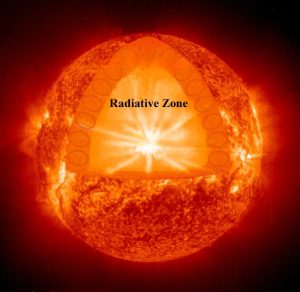
The Sun’s Radiative Zone:
Have you ever wondered what’s happening deep inside the Sun, beyond the glowing surface you see? If you peer into the Sun’s interior (in your mind’s eye, of course), you’ll find that it isn’t a uniform ball of fire at all – it’s layered. Each layer of the Sun is defined by how energy moves through it. Among these layers, the radiative zone stands out as a region where energy travels in a very different way compared to the churning outer layers or the fiery core. In this overview, you’ll discover what the radiative zone is, where it’s located inside the Sun, and how it contrasts with both the central core and the outer convection zone in the way energy is transported. We’ll keep the explanation clear and avoid heavy theory, using analogies to help illustrate the concepts. Let’s explore this fascinating layer with a critical, questioning eye, as any curious astronomer would.
Where Is the Radiative Zone in the Sun
The Sun’s radiative zone is a vast spherical shell inside the Sun, encasing the core and surrounded by the outer convective layer. In terms of position, the radiative zone begins at the outer edge of the core (about 25% of the way out from the Sun’s center) and extends outward to roughly 70% of the Sun’s radius. In other words, if you were traveling outward from the center of the Sun, you’d spend the first quarter of that journey in the core, the next large portion (from 0.25 to 0.70 of the Sun’s radius) trekking through the radiative zone, and the final ~30% of the way in the convective zone near the surface. The radiative zone thus makes up the bulk of the Sun’s interior by radius, acting as a bridge between the core and the convection zone.
It might help to picture the Sun’s interior as an onion-like structure with layers. At the very center is the core – the Sun’s nuclear furnace – which is the hottest, densest part where energy is produced. Just outside that core lies the radiative zone, which you can think of as a thick middle layer. Beyond the radiative zone, closer to the surface, the Sun transitions into the convective zone, where the material moves more like a boiling fluid. The radiative zone, sitting quietly between the explosive core and the bubbling outer layers, has its own unique way of handling the energy that floods out from the core.
How Energy Moves in the Radiative Zone
The radiative zone gets its name from the dominant mode of energy transport there: radiation. But what does that actually mean for the Sun’s plasma? In this zone, energy travels via photons – packets of light – which carry energy outward by repeatedly scattering off particles. Essentially, the radiative zone is like a dense, endless game of photon “pinball”. High-energy photons (initially gamma rays from the core’s fusion reactions) shoot out into the radiative zone and immediately run into a crowd of particles. They are absorbed by one atom and then re-emitted, or deflected off electrons, then absorbed by another particle, and so on. In this manner, the energy generated in the core is passed from particle to particle through the radiative zone, carried by light that bounces from atom to atom.
This process is anything but straightforward – in fact, it’s astonishingly slow and random. Imagine standing in an extremely crowded room where everyone is shoulder-to-shoulder and unable to move. If you wanted to get a message or an object across the room, you’d have to pass it person to person, inching your way through the crowd. For example, picture handing a cup of water to the person next to you, who passes it to the next, and so on, across a packed gymnasium. In the Sun’s radiative zone, the “object” being passed is energy, and each atom is like a person in that crowd, absorbing a photon and later emitting a new one to a neighbor. However, there’s a twist: unlike an orderly bucket brigade where each handoff moves your cup closer to the exit, photons in the radiative zone wander aimlessly. They dart in random directions – sometimes forward, but just as often sideways or even backward. There’s no direct communication guiding them outward. As a result, a photon’s journey from the core through the radiative zone is a long, random walk rather than a straight escape.
You might be surprised (and rightly skeptical) about just how long this random walk takes. After all, photons move at the speed of light – shouldn’t the Sun’s energy blaze out almost instantaneously? The reality is that because the Sun’s inner material is so extraordinarily dense, a photon can only travel a very short distance before hitting another particle and scattering. It loses a bit of energy with each interaction, gradually shifting to longer wavelengths (from gamma rays down to X-rays and ultraviolet as it goes outward). With countless zig-zags and collisions, the net outward progress is painstakingly slow. Estimates vary, but on average it takes on the order of hundreds of thousands of years for energy in the form of these photons to finally emerge from the radiative zone into the next layer. NASA scientists note that an individual photon can bounce around for about a million years just to reach the top of the radiative zone (the point where the next layer begins). In other words, the energy shining from the Sun’s surface today was actually generated in the core long before humans even evolved – a humbling thought for any observer!
Throughout the radiative zone, as energy diffuses outward, the conditions of the plasma change gradually. Both temperature and density drop steadily as you move away from the core. Near the bottom of the radiative zone (just outside the core), temperatures are extremely high – on the order of 7 million °C. By the time you reach the top of the radiative zone (its outer edge), the temperature has fallen to around 2 million °C. Similarly, the density of the solar material decreases from about 20 times the density of solid gold at the bottom of the radiative zone to a density closer to that of water at the top. Despite these changes, the radiative zone remains stably stratified – meaning it does not churn or mix vigorously. The energy flow by radiation is sufficient to carry the heat outward, so the plasma in this region stays in layered, static sheets. You can think of it as a calm deep ocean, with heat radiating through it, in contrast to a boiling pot. But as we’ll see next, this calm can’t continue all the way to the surface – eventually, the Sun needs a different method to transport energy outward.
Comparing the Radiative Zone with the Core and Convection Zone
It’s useful to compare the radiative zone to the layers above and below it to truly understand its role. The Sun’s interior can be divided into three main regions: the core, the radiative zone, and the convective zone. Each of these layers has distinct conditions and a distinct way of moving energy:
The core is the Sun’s innermost region, extending roughly from the center out to about 20–25% of the Sun’s radius. This is the engine room of the Sun where energy is generated through nuclear fusion. Temperatures in the core soar to ~15 million °C, and the density is crushing (over 100 times the density of water). Every second, countless hydrogen nuclei fuse into helium, releasing enormous amounts of energy in the form of high-energy photons (gamma rays) and particles. In the core, conditions are so extreme that energy immediately takes the form of radiation – there’s no question of convection here because the gas is fully ionized and extremely hot, and the energy is carried away by photons almost as soon as it’s produced. However, these photons don’t get far on their own; they quickly enter the surrounding radiative zone and begin their long random walk outward. In summary, the core creates the energy (via fusion) and initially releases it as radiation, which feeds directly into the radiative zone.
Surrounding the core, from about 0.25 to 0.70 of the Sun’s radius, is the radiative zone. Here the key role is transporting the energy outward by radiation (hence the name “radiative” zone). Unlike the core, the radiative zone isn’t generating new energy; it’s a transmission layer. Think of it as a thick insulation layer around the core: it passes energy along, but very slowly. The plasma is extremely hot but gradually cooling with radius (millions of degrees throughout), and it’s dense enough to absorb and re-emit photons constantly. Importantly, the radiative zone is stable and non-convective – the gas here doesn’t rise and fall in large-scale currents. Why not? Essentially, the radiation transfer is still effective enough that the heat can get out without the need for bulk fluid motion. Any given blob of plasma in this zone, if moved upward, would quickly find itself cooler than its surroundings (because the temperature gradient is relatively gentle), so it would sink back down – suppressing convection. Thus, energy flow in the radiative zone is purely by photons carrying heat outward, in contrast to the roiling motions of the layer above. As discussed, those photons take an incredibly long time to work their way through, but they do make it through eventually, all while the radiative zone itself remains in equilibrium.
The convective (or convection) zone is the Sun’s outermost interior layer, occupying roughly the outer 30% of the Sun’s radius (from about 0.7 of the radius to the visible surface). By the time energy reaches the base of the convection zone, the temperature is around 2 million °C – cooler than deeper inside, but still extremely hot. Here something crucial happens: the cooler temperatures allow some heavier ions (like carbon, nitrogen, iron, etc.) to hold onto their electrons, making the plasma more opaque to radiation. In simpler terms, the gas in this region can block and trap radiation much more than the deeper layers did. As a result, photons alone can no longer carry the energy flux outward efficiently – the radiative transfer bogs down. When heat is trapped like this, the stagnant gas gets unstable. The trapped energy makes the plasma hotter and it begins to rise in bulk, just like hot air rising or water boiling in a pot. The Sun thus switches to a different mode of energy transport: convection. In the convection zone, columns of hot plasma heat up and buoyantly rise toward the surface, carrying energy with them, then cool off and sink back down once they’ve released their heat at the surface. This cyclical mass motion – essentially giant circulating currents of gas – rapidly moves energy upward through the convection zone. It’s very much like the bubbling motion in a boiling kettle of water or the circulating blobs in a lava lamp. In fact, if you look at the Sun’s surface with a telescope, you can see evidence of these convective currents: the surface is covered in granules, mottled cell-like structures typically about 1,000 km across, which are the tops of convective cells where hot material is rising in the bright centers and cooler material is sinking along the dark edges. Unlike the radiative zone’s slow and steady photon diffusion, the convection zone is turbulent, dynamic, and fast in transporting energy – convective currents can carry heat to the surface on timescales of days to weeks, a blink of an eye compared to the millennia of photon diffusion in the radiative zone.
In summary, energy flows through the Sun in stages: it’s generated in the core (via fusion), handed off as radiative energy through the radiative zone, and then handed off again via moving matter in the convection zone, finally reaching the Sun’s surface (photosphere) where it escapes as the sunlight we observe. The radiative zone’s role is crucial but often under-appreciated – it serves as the middleman in this process, a quiet conduit through which energy must percolate outward. If you think of the Sun as a giant factory producing light, the core is the production floor, the radiative zone is the long shipping corridor, and the convection zone is the fleet of trucks that finally deliver the goods to the surface.
A Skeptical Look and Final Thoughts
It’s natural to ask: why does the Sun bother with two different methods of energy transport? Couldn’t photons just carry energy all the way out, or conversely, why not start convecting right from the core? The answers lie in the physics of plasma and energy transfer. In the Sun’s deep interior (core and radiative zone), the conditions (high temperature, full ionization, and radiation transparency) make radiative diffusion the dominant and stable mode of energy flow. The radiative zone exists because, at those depths, it’s actually the most efficient way for energy to travel; convection won’t occur as long as radiation can do the job without the gas becoming unstable. However, as you move outward, the plasma changes – it cools just enough to become opaque and clings to heat, and that’s where radiative transfer falters and convection kicks in. The Sun, in a sense, uses whatever means necessary to get the energy out: photons where it can, and mass motion where it must.