
The Sun
Introduction to the Sun

Our Star, the Sun
The Sun is a G2V main-sequence star, often referred to as a yellow dwarf, though it is far from small. It is a typical star by galactic standards, yet to Earth it is the singular source of light, heat, and energy. At about 4.6 billion years old, it is middle-aged, roughly halfway through its 10-billion-year stable hydrogen-fusion lifetime. Its sheer scale is staggering: the Sun’s diameter is nearly 1.4 million kilometers, large enough to fit 109 Earths across its face, and its mass is 1.989 × 10³⁰ kilograms — a figure so vast it accounts for 99.8% of all mass in the solar system.
Light from the Sun takes just over 8 minutes to travel to Earth, yet the photons we see today may have taken thousands of years to migrate from the solar core to the surface. For astronomers, the Sun is not just a familiar beacon in the sky — it is a laboratory of stellar physics, offering direct insight into processes that govern stars across the universe.
Structure of the Sun – Layers of Fire and Plasma
The Sun is not uniform, but layered, each region defined by its physical processes.
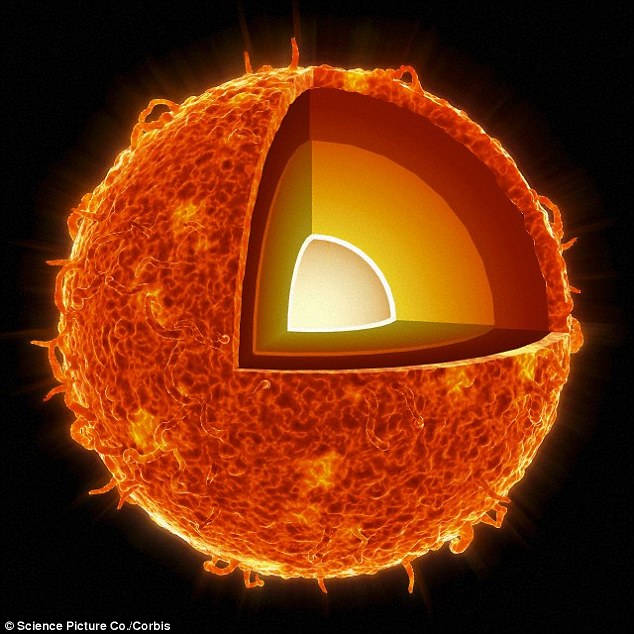
Core – At the very heart of the Sun lies its core—a searing, densely packed region often referred to as the “solar furnace.” This is the engine room of our star, where the temperatures climb to an extraordinary 15 million degrees Celsius (27 million degrees Fahrenheit), and the pressure reaches levels that are utterly incomprehensible by terrestrial standards—over 200 billion times the atmospheric pressure at Earth’s surface.
Within this environment, nuclear fusion occurs. Hydrogen nuclei (protons) are forced together at such immense pressures and temperatures that they overcome their mutual electrostatic repulsion. Through a series of reactions known as the proton-proton chain, these protons fuse to form helium nuclei. This process is astonishingly efficient but only possible under the extreme conditions found in the solar core.
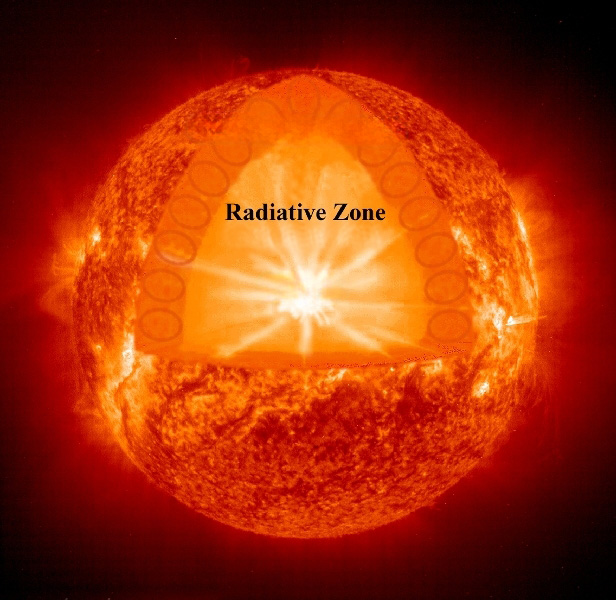
Radiative Zone – Just outside the core is the radiative zone. Energy leaks outward here as light slowly zigzags through very dense, hot gas. Each tiny packet of light (a photon) is absorbed and re-emitted over and over, so it takes a very long time—roughly hundreds of thousands to a million years—to get through.
This zone stretches from the edge of the core out to about 70% of the Sun’s radius. As the light inches outward, it shifts from very high-energy gamma rays toward X-rays and ultraviolet. Around the 70% mark, the gas becomes too “murky” for radiation to carry heat efficiently, and convection takes over in the layer above—hot gas rises, cooler gas sinks, and heat moves by that churning motion.
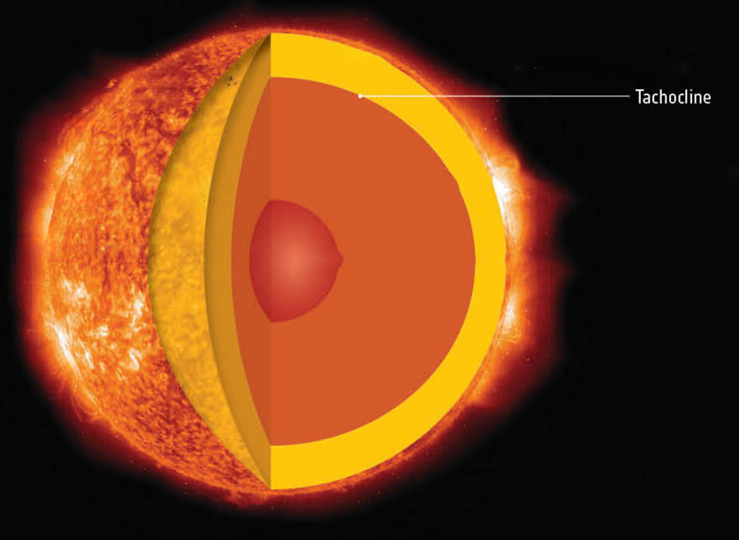
Tachocline – The tachocline is the shear layer that separates a star’s solid-body–like radiative interior from its differentially rotating convective envelope (in stars more massive than roughly a third of the Sun). Across this interface the angular velocity changes rapidly: the convection zone behaves like a normal fluid with latitude-dependent rotation (slow poles, fast equator), while the radiative zone rotates nearly as a solid body—often attributed to stabilizing internal magnetic fields (a “fossil” field is one candidate). In the Sun, the interior rotation rate is close to that observed at mid-latitudes.
Helioseismology places the solar tachocline near 0.70 R☉ (measured from the center) with an estimated thickness of about 0.04 R☉. The resulting strong radial shear is a prime site for amplifying magnetic fields: in many dynamo models, the tachocline’s geometry and width help wind a weaker poloidal field into a stronger toroidal field (the Ω-effect).
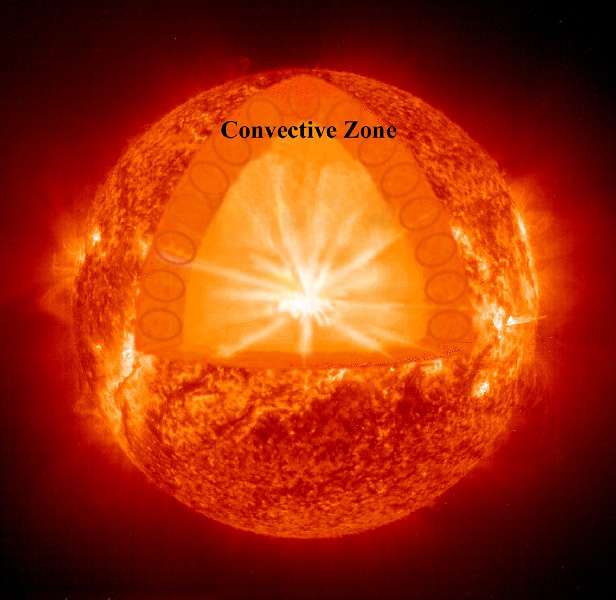
Convective Zone – In this turbulent layer, buoyant hot plasma rises while cooler, denser gas sinks, establishing vigorous convection. These overturning flows imprint the photosphere with granulation—bright cells about 1–2 Mm (million miles) across that live ~5–10 minutes—bounded by darker intergranular lanes where plasma descends. On larger scales, supergranulation spans ~20–30 Mm and persists for roughly a day.
Convection carries energy outward far more efficiently than radiative diffusion in this region, delivering heat up to the photosphere, where radiation becomes the dominant transport. The same motions continuously shuffle magnetic flux and launch acoustic waves, shaping the dynamics of the solar surface and atmosphere.
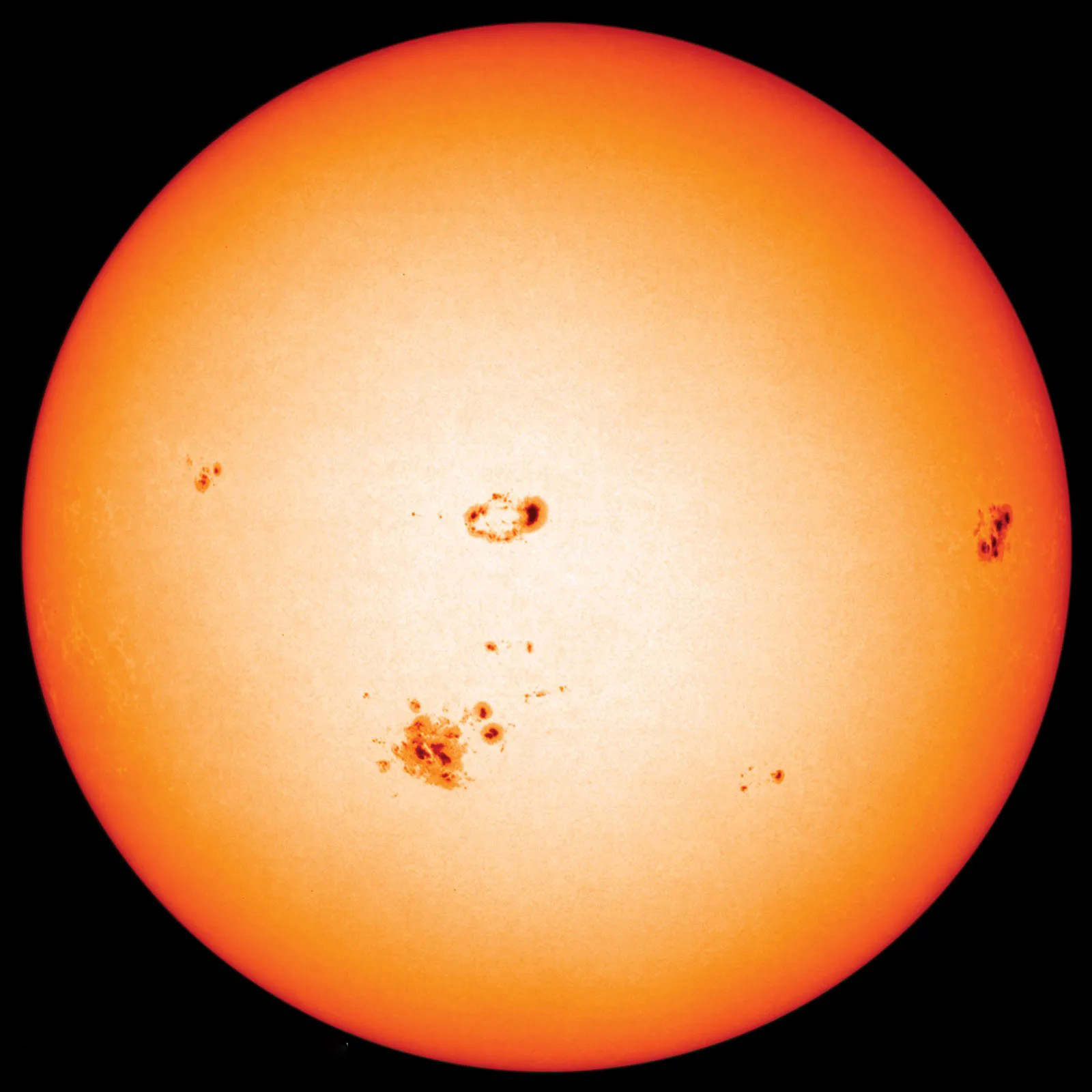
Photosphere – The photosphere is what we perceive as the Sun’s “surface,” though it is not solid—just a tenuous, ~500-km-thick layer where the gas transitions from opaque to transparent (optical depth ≈ 1). Its effective temperature is ~5,770–5,800 K, so it emits most of the visible light we receive, with a spectrum resembling a near–blackbody continuum imprinted by thousands of absorption (Fraunhofer) lines formed higher up.
Structurally, temperature and density fall with height, producing limb darkening: we see into deeper, hotter layers at disk center than near the edge. Magnetically and dynamically, the photosphere hosts sunspots (cool, ~3,800–4,500 K umbrae with strong kilogauss fields), bright faculae and network elements that intensify near the limb, and the cellular granulation pattern—1–2 Mm bright cells bounded by darker intergranular lanes—driven by convective upflows and downflows of roughly 1–2 km/s. On larger scales, supergranulation (~20–30 Mm) organizes magnetic flux into the network.
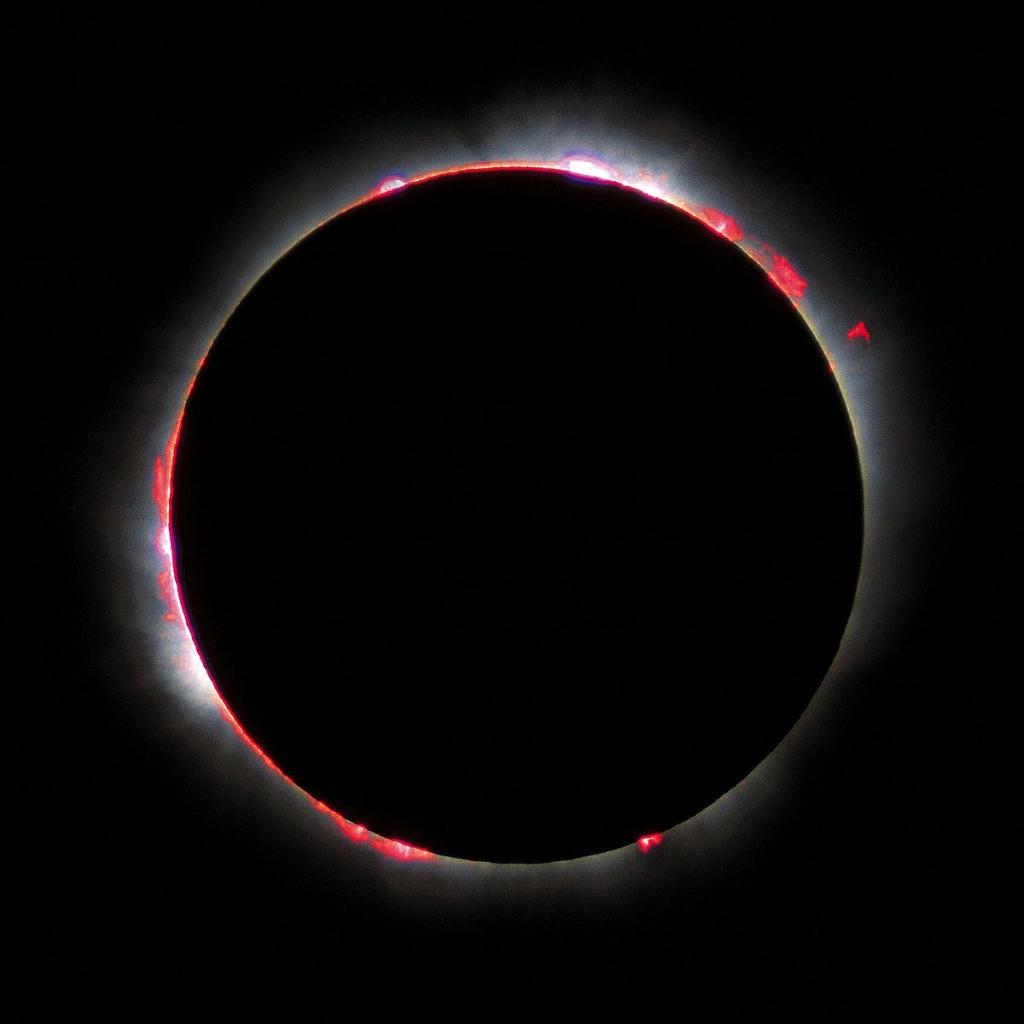
Chromosphere – Above the photosphere lies the chromosphere—a tenuous, ruby-red layer made conspicuous during total solar eclipses and readily observed through narrowband H-α filters (λ ≈ 656.28 nm). Roughly 2,000–3,000 km thick, it sits above the temperature minimum and shows a marked thermal inversion: temperatures rise from ~4,500 K at the base to ≥10,000 K toward the top. It is also bright in Ca II H & K (396.8/393.4 nm), key diagnostics of its structure and dynamics.
The chromosphere is highly dynamic. Narrow jets called spicules—typically 200–500 km wide—shoot upward along magnetic field lines to heights of 5,000–10,000 km. “Type I” spicules last ~3–7 minutes and rise at ~20–30 km s⁻¹; “Type II” spicules are shorter-lived (~50–150 s) and faster (~50–150 km s⁻¹), often fading as their plasma heats. Additional features include fibrils, mottles, plages, and filament channels that trace the magnetic network along supergranular cell boundaries.

Corona – the Sun’s outer atmosphere—extends for many solar radii into interplanetary space. Though extremely tenuous (electron densities near the base ~10⁸–10⁹ cm⁻³), it is astonishingly hot: ~1–3 MK in quiet regions and >10 MK in active regions and flares, far hotter than the ~5,800 K photosphere below. Explaining this temperature inversion—the coronal heating problem—remains an active research area, with leading candidates including the dissipation of MHD waves (especially Alfvén waves), ubiquitous small-scale magnetic reconnection (“nanoflares”), and turbulence driven by braided field lines. The corona is optically thin and seen directly during total solar eclipses in white light, and routinely in EUV and X-rays from space.
Open magnetic field regions (coronal holes) allow plasma to escape as the solar wind. The fast wind (~700–800 km s⁻¹) typically originates from these holes, while the slow wind (~300–500 km s⁻¹) is associated with the streamer belt and interchange reconnection near closed-field boundaries. As it expands, the wind becomes supersonic, carries the interplanetary magnetic field into a Parker spiral, and drives space-weather effects throughout the heliosphere. The Sun’s outer atmosphere extends millions of kilometers into space. Despite being extremely thin, it reaches temperatures of millions of degrees — far hotter than the photosphere below. This paradox remains one of the great unsolved mysteries of solar physics. The corona is the origin of the solar wind, a constant outflow of charged particles.