
cancer
Welcome to the Cancer Page!
Cancer constellation is located in the northern sky. Its name means “the crab” in Latin. Cancer is the faintest of the 12 zodiac constellations. Its symbol is ♋. The constellation was first catalogued by the Greek astronomer Ptolemy in his Almagest in the 2nd century CE.
In Greek mythology, the constellation Cancer is associated with the crab sent by Hera to defeat Heracles. In different versions of the myth, the crab is either kicked into the sky by Heracles or placed among the stars by Hera after getting crushed by the Greek hero.
Cancer contains a number of famous deep sky objects, among them the open cluster Praesepe, also known as the Beehive Cluster (Messier 44), the open cluster Messier 67, and the interacting spiral galaxies NGC 2535 and NGC 2536.
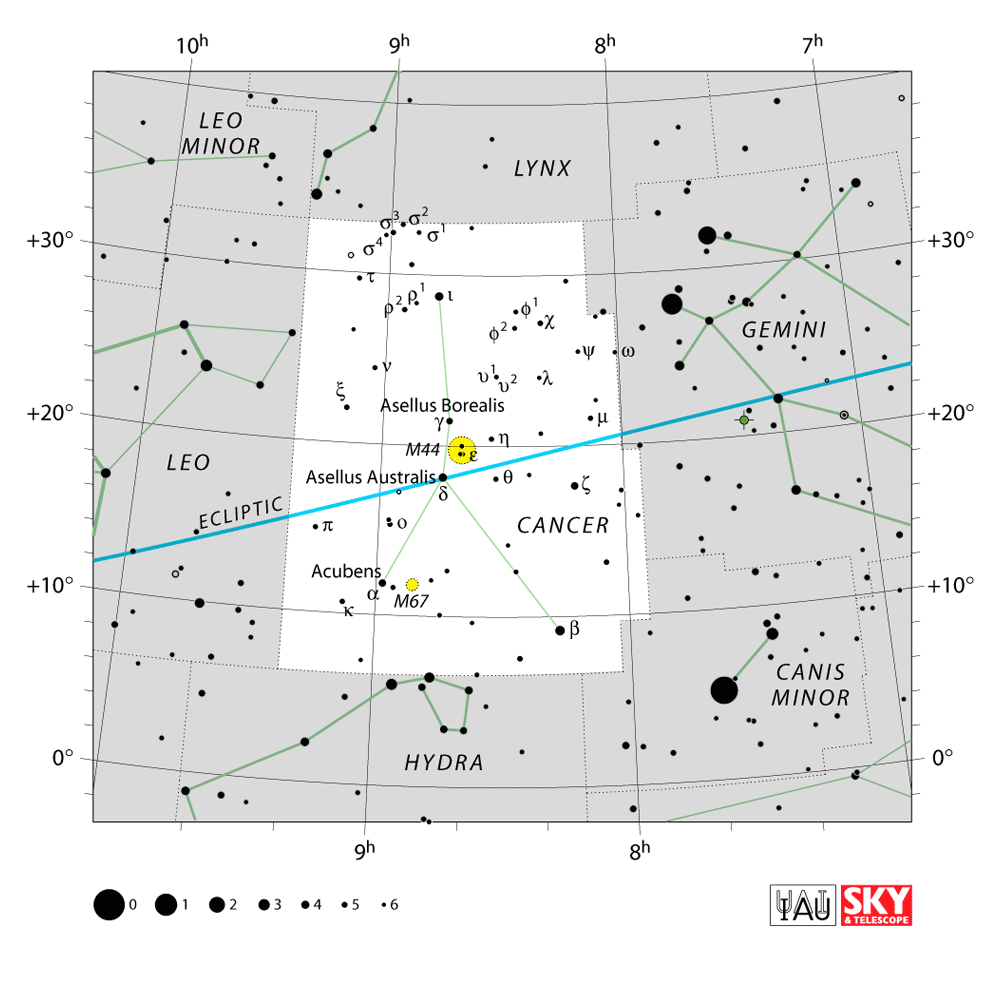
FACTS
Cancer is the 31st largest constellation in the sky, occupying an area of 506 square degrees. It lies in the second quadrant of the northern hemisphere (NQ2) and can be seen at latitudes between +90° and -60°. The neighboring constellations are Canis Minor, Gemini, Hydra, Leo, Leo Minor, and Lynx.
The constellation name Cancer is pronounced /ˈkænsər/. In English, the constellation is known as the Crab. The genitive form of Cancer, used in star names, is Cancri (pronunciation: /ˈkæŋkraɪ/). The three-letter abbreviation, adopted by the International Astronomical Union (IAU) in 1922, is Cnc.
Cancer belongs to the zodiac family of constellations, along with Aries, Taurus, Gemini, Leo, Virgo, Libra, Scorpius, Sagittarius, Capricornus, Aquarius, and Pisces.
Cancer contains two Messier objects – the Beehive Cluster (M44, NGC 2632) and M67 (NGC 2682) – and has two stars with known planets. The brightest star in the constellation is Al Tarf, Beta Cancri. The Delta Cancrids are the only meteor shower associated with the constellation.
Cancer contains 11 named stars. The proper names of stars that have been officially approved by the International Astronomical Union (IAU) are Acubens, Asellus Australis, Asellus Borealis, Copernicus, Gakyid, Kaewkosin, Meleph, Nahn, Piautos, Tarf, and Tegmine.
Acubens, Alpha Cancri, is only the fourth brightest star in Cancer. Its apparent magnitude varies between 4.20 and 4.27.
The star is sometimes also called Al Zubanah or Sertan. The name Al Zubanah comes from the Arabic az-zubānah, which means “claws,” while Sertan is derived from saraţān, which means “the crab.”
Alpha Cancri is a multiple star system located approximately 174 light years from Earth. The brightest component, Alpha Cancri A, is a white A-type main sequence dwarf. The star has an eleventh magnitude companion, Alpha Cancri B. The brighter star in the system is suspected to be a very close binary itself, consisting of two stars separated by 0.1 arc seconds.
Acubens belongs to the spectral class A5m and has a luminosity 23 times that of the Sun. The star lies close to the ecliptic and can be occulted by the Moon and, rarely, by planets.
MYTHOLOGY
In mythology, Cancer is associated with the crab in the story of the Twelve Labours of Heracles (represented by the Hercules constellation). In the myth, Hera sends the crab to distract Hercules while the hero is fighting the Lernaean Hydra, the serpent-like beast with many heads and poisonous breath, represented by the Hydra constellation. When the crab approaches Hercules, the hero kicks it all the way to the stars.
In another version, the crab gets crushed instead and Hera, a sworn enemy of Hercules, places it in the sky for its efforts. However, she places the crab in a region of the sky that has no bright stars, because despite its efforts, the crab was not successful in accomplishing the task. Cancer does not have any stars brighter than fourth magnitude.