
Camelopardalis
Welcome to the Camelopardalis Page!
Camelopardalis constellation lies in the northern hemisphere. Its name comes from the Latin derivation of the Greek word for “giraffe.”
Taken apart, the word camelopardalis means camel (Greek kamēlos) and leopard (pardalis). The giraffe was called the “camel-leopard” because it had a long neck like a camel and a body with spots, like a leopard.
The constellation was created by the Dutch astronomer Petrus Plancius and documented by the German astronomer Jakob Bartsch in 1624. It contains Kemble’s Cascade, an asterism formed by a cascade of relatively faint stars, and several notable deep sky objects: the open cluster NGC 1502, the Oyster Nebula (NGC 1501), the spiral galaxies NGC 2403 and IC 342 (the Hidden Galaxy), and the dwarf irregular galaxy NGC 1569.
FACTS
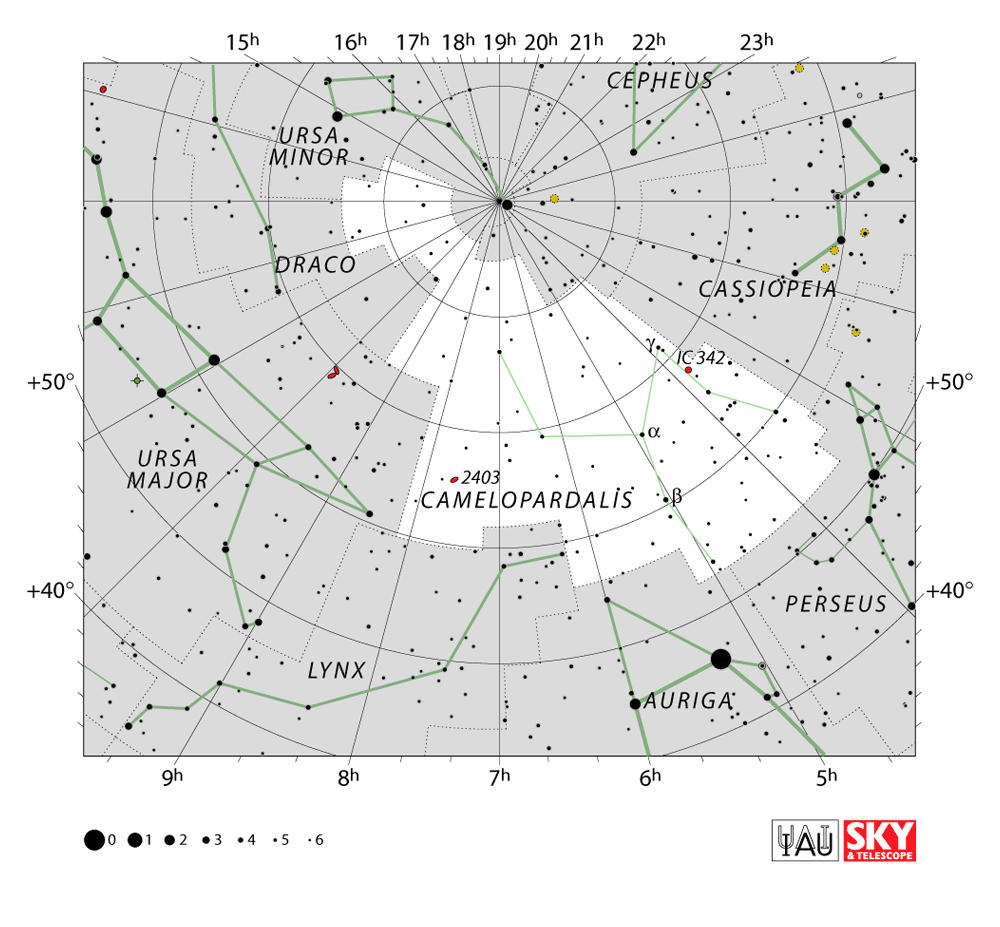
Camelopardalis is the 18th largest constellation in the night sky, occupying an area of 757 square degrees. It is located in the second quadrant of the northern hemisphere (NQ2) and can be seen at latitudes between +90° and -10°. The neighboring constellations are Auriga, Cassiopeia, Cepheus, Draco, Lynx, Perseus, Ursa Major, and Ursa Minor.
The constellation name Camelopardalis is pronounced /kəˌmɛloʊˈpɑːrdəlɪs/. In English, the constellation is known as the Giraffe. The genitive form of Camelopardalis, used in star names, is Camelopardalis (pronunciation: /kəˌmɛloʊˈpɑːrdəlɪs/). The three-letter abbreviation, adopted by the International Astronomical Union (IAU) in 1922, is Cam.
Camelopardalis belongs to the Ursa Major family of constellations, along with Boötes, Canes Venatici, Coma Berenices, Corona Borealis, Draco, Leo Minor, Lynx, Ursa Major, and Ursa Minor.
Camelopardalis has three stars with known planets and no Messier objects. The brightest star in the constellation is Beta Camelopardalis. The October Camelopardalids are the only meteor shower associated with the constellation.
Camelopardalis contains two formally named stars. The star names approved by the International Astronomical Union (IAU) are Mago and Tonatiuh.
Beta Camelopardalis is the brightest star in the constellation. It is a binary star with a yellow G-type supergiant for the primary component. It is approximately 1,000 light years distant and has an apparent magnitude of 4.03. CS Camelopardalis, the second brightest star in Camelopardalis, is also a binary. It consists of a blue-white B-type supergiant and a magnitude 8.7 star located 2.9 arc seconds away. The star is located in the reflection nebula vdB 14.
CS Camelopardalis A is an Alpha Cygni type variable star, one that exhibits non-radial pulsations (which means that some portions of the star’s surface expand while others contract), with luminosity varying from magnitude 4.19 to 4.23. The star is approximately 3,000 light years distant.
Beta Camelopardalis is the brightest star in the constellation. It is a binary star with a yellow G-type supergiant for the primary component. It is approximately 1,000 light years distant and has an apparent magnitude of 4.03.
CS Camelopardalis, the second brightest star in Camelopardalis, is also a binary. It consists of a blue-white B-type supergiant and a magnitude 8.7 star located 2.9 arc seconds away. The star is located in the reflection nebula vdB 14.
CS Camelopardalis A is an Alpha Cygni type variable star, one that exhibits non-radial pulsations (which means that some portions of the star’s surface expand while others contract), with luminosity varying from magnitude 4.19 to 4.23. The star is approximately 3,000 light years distant.
Kemble’s Cascade is an asterism formed by more than 20 stars between magnitude 5 and 10 that form a straight line in the sky. The line stretches over a distance of five moon diameters and ends at an open star cluster, NGC 1502.
The asterism was named after Father Lucian J. Kemble, a Franciscan Friar who discovered it and wrote a letter to Walter Scott Houston (columnist for Sky and Telescope magazine) describing the sight as “a beautiful cascade of faint stars tumbling from the northwest down to the open cluster NGC 1502.” Houston named the asterism Kemble’s Cascade in his “Deep Sky Wonders” column in Sky and Telescope in 1980.
STORY
The Giraffe constellation is pretty faint, with no stars brighter than fourth magnitude. The Greeks did not see any stars in Camelopardalis and thought this region of the sky, as well as what is now the constellation Lynx, was empty. There are no myths associated with the constellation as it was only created in the 17th century.
While the giraffe is not a reference to mythology, the constellation’s name could be a reference to the book of Genesis in the Bible, but this remains doubtful. When Jacob Bartsch included Camelopardalis on his star map of 1624, he described the constellation as a camel on which Rebecca rode into Canaan, where she was to marry Isaac. Since Camelopardalis represents a giraffe and not a camel, this explanation does not seem likely.