
Bootes
Welcome to the Bootes Page!
Boötes is one of the largest constellations in the sky. Located in the northern celestial hemisphere, the constellation is dominated by the Kite, a diamond-shaped asterism formed by its brightest stars.
The constellation’s name comes from the Greek word Βοώτης, Boōtēs, which means ox driver, plowman, or herdsman. Boötes was first catalogued by the Greek astronomer Ptolemy in the 2nd century.
The constellation is home to the contrasting double star Izar and Arcturus, the brightest star in the northern celestial hemisphere and third individual brightest star in the sky, after Sirius in Canis Major and Canopus in Carina constellation.
FACTS
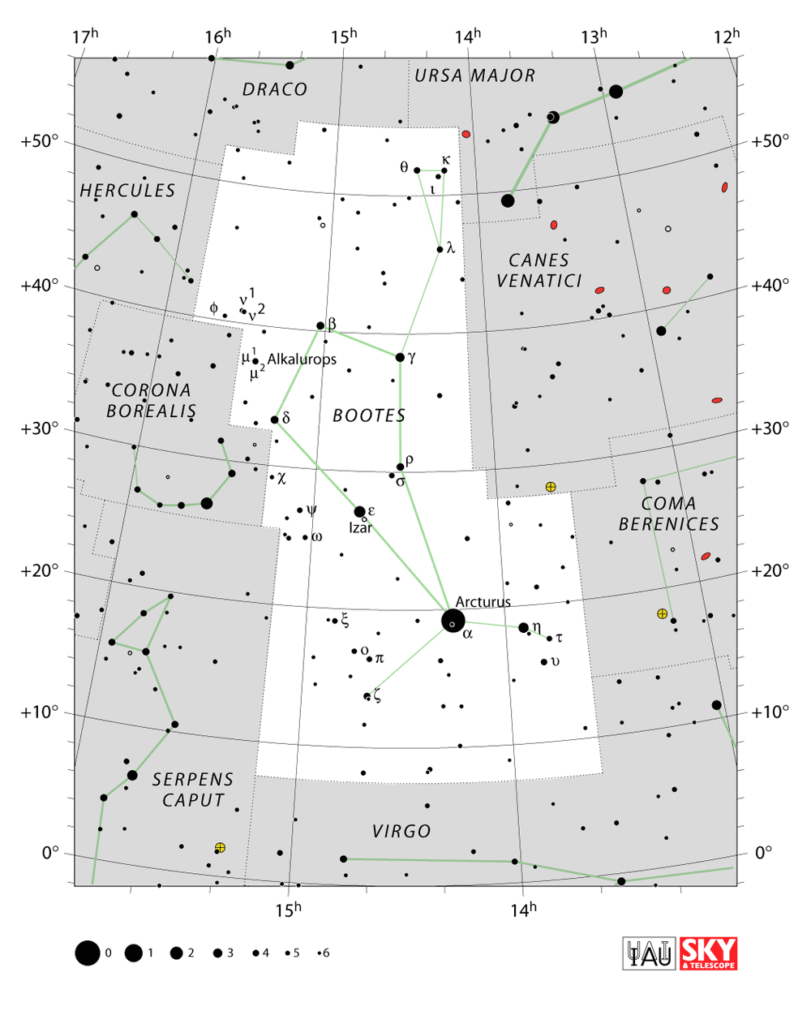
Boötes is one of the largest constellations in the sky. Located in the northern celestial hemisphere, the constellation is dominated by the Kite, a diamond-shaped asterism formed by its brightest stars.
The constellation’s name comes from the Greek word Βοώτης, Boōtēs, which means ox driver, plowman, or herdsman. The correct pronunciation is /boʊˈoʊtɨs/, with each ‘o’ pronounced separately and stress on the second syllable. Boötes was first catalogued by the Greek astronomer Ptolemy in the 2nd century.
The constellation is home to the contrasting double star Izar and Arcturus, the brightest star in the northern celestial hemisphere and the third brightest star in the sky, after Sirius in Canis Major and Canopus in the Carina constellation.
Boötes is the 13th largest constellation in the night sky, occupying an area of 907 square degrees of the northern sky. It is located in the third quadrant of the northern hemisphere (NQ3).The entire constellation is visible from locations between the latitudes +90° and -50°. The neighboring constellations are Canes Venatici, Coma Berenices, Corona Borealis, Draco, Hercules, Serpens Caput, Virgo, and Ursa Major.
The constellation name Boötes is pronounced /boʊˈoʊtiːz/. In English, the constellation is known as the Herdsman. The genitive form of Boötes, used in star names, is Boötis (pronunciation: /boʊˈoʊtɪs/). The three-letter abbreviation, adopted by the International Astronomical Union (IAU) in 1922, is Boo.
Boötes belongs to the Ursa Major family of constellations, along with Camelopardalis, Canes Venatici, Coma Berenices, Corona Borealis, Draco, Leo Minor, Lynx, Ursa Major, and Ursa Minor.
The brightest star in the constellation is Arcturus (Alpha Boötis). With an apparent magnitude of -0.05, the red giant is the brightest star in the northern celestial hemisphere and the fourth brightest star in the sky, after Sirius, Canopus and Alpha Centauri.
The nearest star in Boötes is Gliese 526 (Wolf 498, Lalande 25372), a red dwarf located 17.726 light-years away.
The celestial Herdsman contains 10 stars with known planets. The orange subgiant HD 141399 is home to a planetary system consisting of at least four massive gas giants. The K-type dwarf HN Boötis (HD 128311) has two confirmed planets and a third unconfirmed candidate.
Other stars with extrasolar planets include the yellow-white main sequence stars Tau Boötis and WASP-14, the yellow giants Nikawiy (HD 136418) and 24 Boötis, the orange subgiant Arcalís (HD 131496), the yellow dwarfs HD 132406 and HAT-P-4, and the yellow-white giant HD 132563.
The constellation Boötes contains 11 named stars. The star names approved by the International Astronomical Union (IAU) are Alkalurops (Mu1 Boötis), Arcalís (HD 131496), Arcturus (Alpha Boötis), Izar (Epsilon Boötis A), Merga (38 Boötis), Muphrid (Eta Boötis A), Nekkar (Beta Boötis), Nikawiy (HD 136418), Quadrans (44 Boötis A), Seginus (Gamma Boötis Aa), and Xuange (Lambda Boötis).
Boötes does not contain any Messier objects. There are three meteor showers associated with the constellation: the January Bootids, the June Bootids, and the Quadrantids.
The best time of the year to observe Boötes is during the month of June, when the constellation appears higher in the sky around 9 pm.
MYTHOLOGY
Boötes is traditionally depicted as a herdsman with two hunting dogs on a leash and a club in his other hand. In the sky, Boötes follows Ursa Major around the pole. In one story, the constellation represents a ploughman driving the oxen in the Ursa Major constellation, followed by his two dogs, Asterion and Chara (represented by the constellation Canes Venatici, the Hunting Dogs). The ploughman’s oxen are tied to the polar axis and their movement keeps the skies in constant rotation
Most commonly, Boötes is taken to represent Arcas, son of Zeus and Callisto, daughter of the Arcadian king Lycaon. Arcas was brought up by his grandfather, the king, who one day decided to test Zeus by serving him his own son for a meal.
Zeus, however, saw through Lycaon’s intentions, transformed the cruel king into a wolf, struck down all his sons with thunderbolts, and brought Arcas back to life.
Zeus’ wife Hera, having heard of her husband’s disloyalty, transformed Callisto into a bear. Callisto roamed the woods until years later she met her son, who was now grown up. Arcas didn’t recognize his mother and began to chase her. Callisto hid herself in a temple, where he could not hurt her without risking being convicted for defiling a sacred place. To avoid a tragedy, Zeus placed both of them in the sky; Callisto as Ursa Major and Arcas as Boötes.
In another story, Boötes is taken to represent Icarius, a grape grower who once invited Dionysus to visit his vineyards. The god was so impressed that he gave Icarius the secret of making wine. Icarius followed the recipe and enjoyed the beverage so much that he invited all his friends to try it. However, they had never tried wine before and, when they woke up the next day not feeling well, they assumed Icarius had tried to poison them. Angry, they did away with him while he slept. Dionysus was saddened by the passing of his friend and decided to place Icarius among the stars. In another myth, Boötes is credited for inventing the plough, which prompted the goddess Ceres to place him in the heavens.